The short answer
Choose packing cubes when you want clothes separated, easy to find, and quick to move between a suitcase and a hotel drawer. Choose compression bags when your main problem is volume from soft, bulky items such as a puffer jacket, fleece, or spare bedding.
Compression can create room, but it does not make your luggage lighter. That distinction matters for carry-on travel: a smaller-looking load can still exceed an airline’s weight policy. The safest approach is to check your airline’s current size and weight rules before leaving, then weigh the finished bag.
Packing cubes vs. compression bags at a glance
| Factor | Packing cubes | Compression bags |
|---|---|---|
| Main job | Organize clothing by category or outfit | Reduce the volume of compressible items |
| Access during a trip | Fast; unzip the cube you need | Slower; open and recompress the bag |
| Wrinkle risk | Usually lower when cubes are not overfilled | Usually higher when clothing is tightly compressed |
| Equipment | No equipment | Roll-up bags need no pump; vacuum bags may need one |
| Best for | Shirts, pants, underwear, socks, family sorting | Jackets, fleece, soft bulky layers |
| Common mistake | Using too many cubes | Filling the saved space until the bag is overweight |
What packing cubes do well
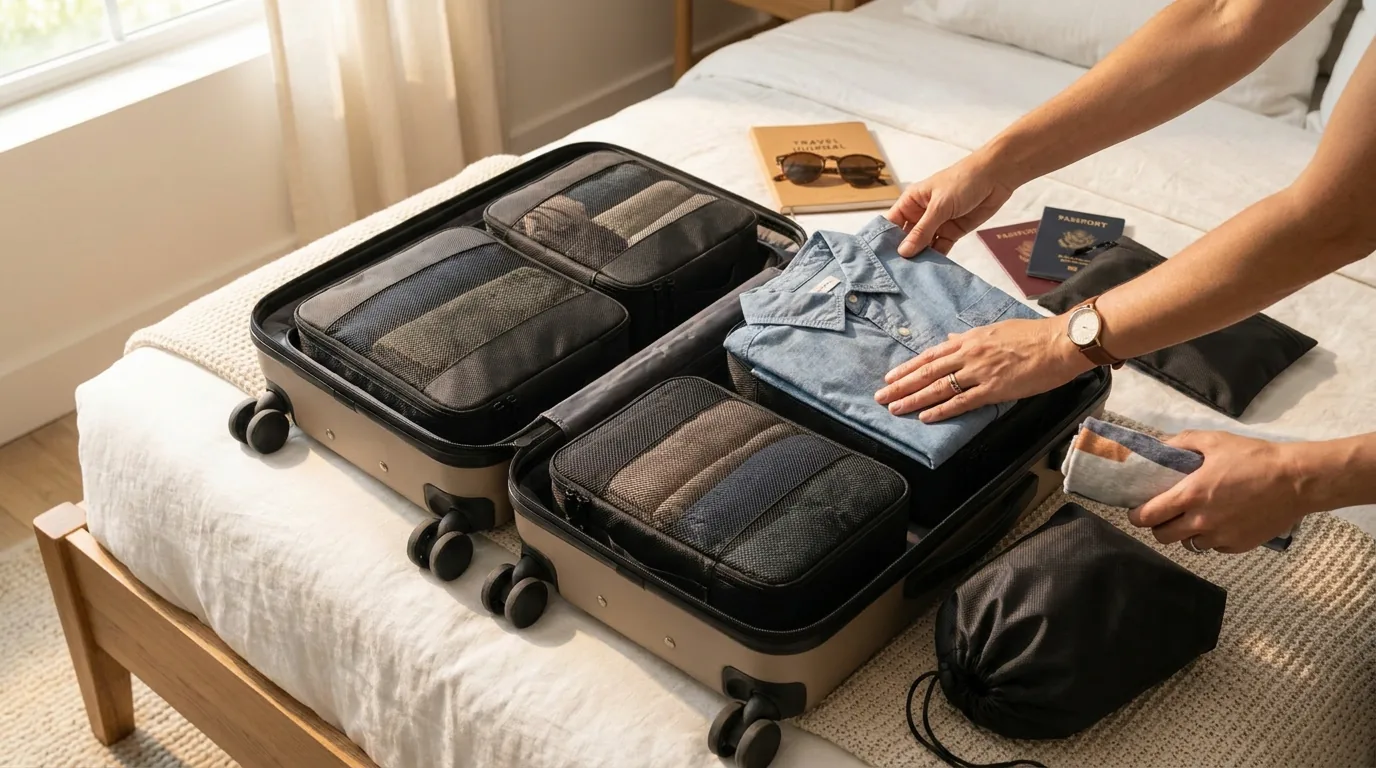
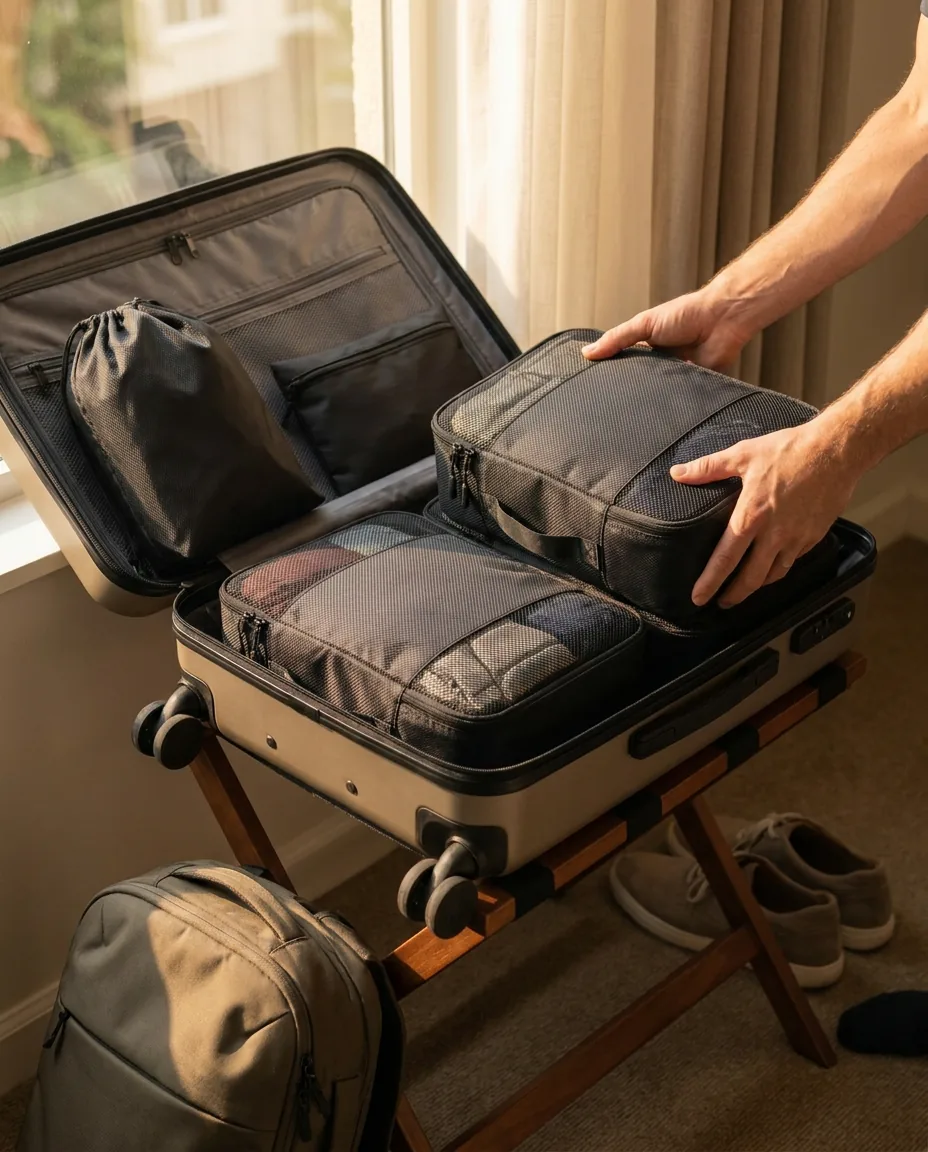
Packing cubes create zones inside a suitcase. One cube can hold tops, another underwear and socks, and another workout or sleepwear. That makes the contents predictable: you can reach one category without disturbing everything else.
They are especially useful on multi-stop trips because the system survives repeated packing. A cube can move into a drawer, back into the suitcase, and into a weekend bag without being rebuilt from scratch. Families can also assign one cube or color to each traveler; our family packing cube guide shows a simple version of that setup.
Standard cubes do not remove air aggressively. Their value is structure, not dramatic volume reduction. They may help clothes stay compact because folded or rolled items cannot spread across the suitcase, but an overfilled cube becomes harder to zip and can create a dense block that is awkward to place.
What compression bags do well
Compression bags remove excess air or squeeze soft items into a smaller shape. Vacuum-style bags use suction; roll-up travel bags push air through a one-way valve as you roll them. Both can help when a few bulky pieces are consuming most of the suitcase.
The tradeoff is access. If you open a compressed bag during a trip, you must compress it again. A vacuum bag can also be inconvenient when the return location has no compatible vacuum. Roll-up bags avoid that equipment problem but can still produce an uneven or rigid bundle.
Compression is also a poor substitute for editing a packing list. Saving volume can tempt you to add more items, increasing weight and making the carry-on difficult to lift. Check the airline’s current carry-on limits, and use the TSA “What Can I Bring?” directory when an item itself may be restricted.
Which is better for a carry-on?
For a typical three-to-seven-day trip, packing cubes are usually better. They solve the problem travelers face every day—finding and repacking clothing—without adding a recompression step. Start with two or three cubes rather than filling every inch with organizers.
Compression bags become useful when the trip includes cold-weather layers or another unusually bulky soft item. In that case, use one compression bag for the bulky category and packing cubes for the rest. The hybrid approach prevents a jacket from taking over the suitcase while keeping daily clothing easy to access.
Best choice by trip type
Weekend trip
Use one medium cube for main clothing and one small cube for underwear and socks. Compression is rarely necessary unless you are carrying winter outerwear. See our weekend bag packing setup.
Business trip
Use lightly filled cubes so shirts and trousers are not crushed. Keep shoes and toiletries separate. Tight compression is a poor choice for wrinkle-prone clothing.
Family trip
Use cubes to separate people or daily outfits. Easy identification is usually more valuable than maximum compression, especially when several people share one suitcase.
Cold-weather trip
Use a compression bag for fleece, thermals, or a packable jacket, then keep ordinary outfits in cubes. Wear the bulkiest coat in transit when practical.
Long multi-stop trip
Favor cubes. You will open and close the bag repeatedly, so dependable access beats one-time space savings.
A practical hybrid setup
- Lay out everything before choosing containers.
- Remove duplicates and “just in case” clothing first.
- Put everyday tops and bottoms in one packing cube.
- Use a smaller cube for underwear, socks, and sleepwear.
- Compress only the single bulkiest soft category.
- Leave liquids, medication, electronics, and screening items easy to reach.
- Close and weigh the finished bag; do not judge compliance by appearance.
If you are new to cubes, follow the step-by-step layout in How to Use Packing Cubes for a Cleaner Carry-On.
Common mistakes to avoid
- Assuming smaller means lighter: compression changes volume, not mass.
- Compressing everything: dense bundles can be awkward and make clothes more wrinkled.
- Forgetting the return trip: make sure you can recreate the packed setup without special equipment.
- Overfilling cubes: a cube should organize clothing, not strain its zipper.
- Burying essentials: keep travel documents, medication, chargers, and screening items accessible.
Bottom line
Packing cubes win for organization, access, and repeated use. Compression bags win for reducing the volume of a limited number of bulky, soft items. Most carry-on travelers should begin with packing cubes and add one compression bag only when the itinerary or climate creates a real bulk problem.