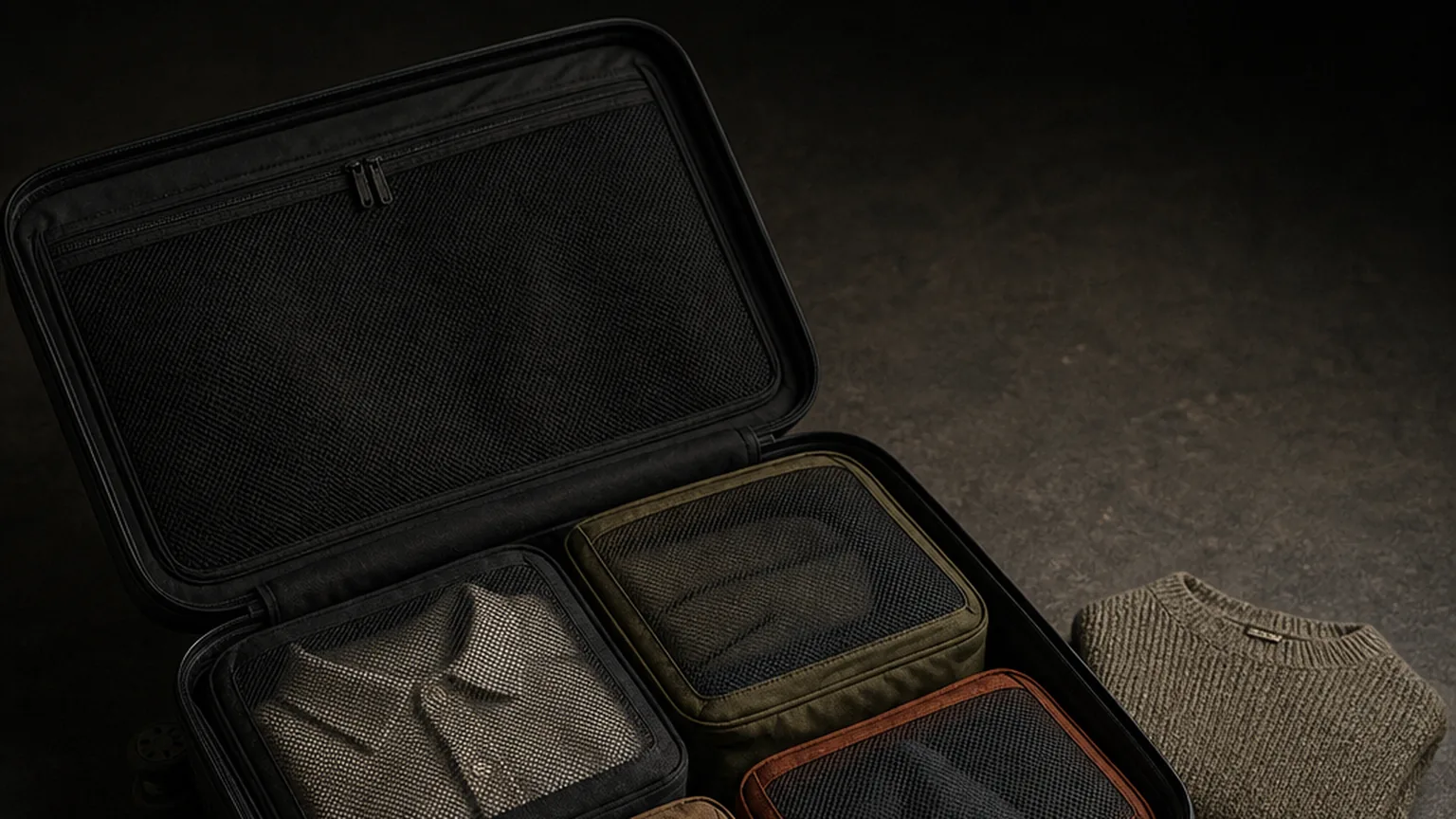
The short answer
Packing cubes are usually worth buying if you travel more than occasionally, change hotels during a trip, share luggage, or dislike digging through a loose pile of clothes. They keep clothing categories together, make it easier to remove one group without disturbing the rest of the suitcase, and can move straight into a drawer or shelf at your destination.
The honest limitation is that ordinary cubes mainly create order. They do not remove air with a vacuum, change the weight of your clothing, or guarantee that more items will fit. Independent testers at Wirecutter and the travel-gear specialists at Pack Hacker both treat organization as the core benefit. Compression cubes add a second zipper or another mechanism to reduce clothing volume, but they introduce extra effort and can become awkward when overfilled.
Think of the decision this way: packing cubes are worth it when they reduce friction during the trip—not merely when they help you force more clothing into the bag.
Packing cubes at a glance
| Your priority | Are cubes worth it? | Best approach |
|---|---|---|
| Fast access and tidy unpacking | Usually yes | Use two to four regular cubes with clear clothing categories. |
| Maximum space for soft clothing | Maybe | Use compression cubes carefully, or compare them with compression bags. |
| Lowest possible bag weight | Only if lightweight | Choose light cubes and pack less rather than filling every new gap. |
| One short, simple trip | Not essential | A neat folded or rolled stack may work just as well. |
| Family or shared luggage | Often yes | Assign a cube by person, clothing type, or day of arrival. |
| Rigid or irregular gear | Limited value | Use cubes for clothing and fit hard objects around them. |
What packing cubes do well
They turn one large space into useful zones
A suitcase is usually one big container with a few pockets. Cubes let you create practical sections without permanently changing the bag. Shirts can stay separate from bottoms; underwear and socks can stay in a small cube; workout clothing or sleepwear can have its own zone when that separation matters.
This is especially useful when the trip involves repeated packing. Instead of rebuilding the whole suitcase every morning, you can close two or three cubes and move on. Condé Nast Traveler’s organizer guidance notes that cubes can be arranged by garment category, complete outfit, person, or clean and dirty status. The best system is the one you can understand at a glance.
They make access and unpacking faster
A cube can move from the suitcase to a hotel drawer as one unit. If security, a weather change, or an overnight stop requires access to one category, you can remove that cube without scattering every garment. Pack Hacker identifies easier packing, unpacking, and transfer between bags as central benefits.
The benefit grows on multi-stop trips. A traveler staying in one place for a week may unpack once, but someone changing hotels every two nights repeatedly pays the cost of a messy bag. For that traveler, cubes can save time even if they do not save physical space.
They help reveal overpacking
Cubes create visible limits. If the tops cube will not close without force, the better answer may be to remove two shirts—not to lean harder on the zipper. Laying out clothing by category before filling the cubes can also make duplicate and “just in case” items easier to spot.
That discipline matters because organization can otherwise hide excess. A perfectly divided suitcase can still be too heavy. Long-time travel educator Rick Steves emphasizes packing less as the reliable way to reduce luggage weight and improve mobility.
Where packing cubes fall short
Standard cubes do not automatically save space
A regular cube contains clothing in a tidy shape, but the fabric inside still occupies volume. The neat rectangle may fit a suitcase efficiently, or it may leave awkward gaps around shoes, toiletry bags, wheel housings, and rigid items. That is why the answer to “Do packing cubes save space?” is usually not by themselves.
Compression cubes are different. A second zipper can squeeze soft clothing into a smaller volume, but performance depends on the design, the fabric, and how evenly the cube is loaded. Wirecutter’s testing warns that uneven overpacking can turn a cube into a rounded, football-like shape that is harder to place. If space is your main concern, read our packing cubes vs. compression bags comparison before choosing a system.
They add a little material and weight
Every cube adds fabric, zippers, seams, and handles. Lightweight models may add very little, while structured or divided cubes add more. This matters most when an airline weight limit is tight or when you carry the bag over long distances.
Compression also creates a temptation: once a sweater takes less room, another sweater suddenly fits. The bag becomes smaller in volume but not lighter in weight. Use the freed space for breathing room, not as an automatic invitation to add more.
They are poor containers for some items
Rigid objects, bulky shoes, toiletries, electronics, and odd-shaped gear often fit better around soft cubes than inside them. Condé Nast Traveler’s expert advice makes the same practical point: not every object belongs in a cube, and cubes do not always need to lie flat.
Items needed during the journey also deserve accessible places. Travel documents, medicine, liquids for screening, a charger, and an in-flight layer should not be buried simply to make the suitcase look uniform.
They can encourage an overcomplicated system
One cube for every day or outfit sounds orderly, but it can create too many small containers. If you need to open three cubes to dress once, the organization is working against you. A good system needs only a few clear labels in your head: tops, bottoms, base layers, or one cube per person.
Who gets the most value from packing cubes?
- Frequent travelers: the packing and unpacking time saved is repeated across many trips.
- Multi-stop travelers: clothing can stay organized without rebuilding the suitcase at every hotel.
- Families and couples sharing luggage: cubes create clear ownership and reduce mix-ups. Our family packing cube guide shows a simple shared-bag system.
- Travelers with mixed clothing needs: workwear, casual clothes, sleepwear, and activity gear can stay separate.
- People who live from the suitcase: cubes function as removable drawers when storage is limited.
They are less compelling for a one-night trip, a highly compartmentalized backpack, or a minimalist traveler carrying one small clothing stack. In those cases, a rubber band, lightweight pouch, or careful fold may solve the problem with less equipment.
Regular cubes, compression cubes, or no cubes?
Choose regular cubes for organization
Regular mesh or fabric cubes are the simplest choice when the goal is visibility, separation, and quick access. They are easier to load than compression models and place less pressure on zippers and garments. For many travelers, this is enough.
Choose compression cubes for bulky soft items
Compression cubes are most useful for sweaters, fleece, sleepwear, and other soft items that hold air. They can reduce volume, but they may wrinkle clothing and become difficult to zip when loaded unevenly. Eagle Creek’s category guide distinguishes regular cubes for organization, compression cubes for moderate volume reduction, and compression bags for stronger compression. That is manufacturer guidance rather than a universal performance promise, but the categories are useful.
Skip cubes when the bag already solves the problem
A clamshell backpack with strong internal dividers may not need additional containers. The same is true when a short trip has only one neat clothing stack. Do not buy a system to solve a problem your bag and packing list do not have.
How to test whether packing cubes are worth it for you
- Pack once without cubes. Use the clothing you actually plan to bring, then note what becomes hard to find or keep neat.
- Create two or three categories. Start with tops; bottoms; underwear, socks, and sleepwear.
- Load the cubes without straining them. A zipper should close without forcing fabric into its path.
- Place shoes and rigid items afterward. Let those pieces occupy natural gaps instead of forcing them into rectangles.
- Remove one item you may need first. If the cube system makes that easier, it is doing useful work.
- Weigh the finished bag. Confirm that better organization did not quietly become more clothing.
For a solo carry-on, two to four cubes are usually enough. Our carry-on cube count guide explains when to start with two, three, or four. If you are deciding how to load each cube, our rolling vs. folding guide covers access, shape, and wrinkle tradeoffs.
How an eight-piece set can still be practical
The current CobaltNook gear page presents an eight-piece packing cube set. An eight-piece set is a pool of options, not a requirement to put all eight pieces in one suitcase. A solo carry-on may use only three pieces, while the rest support a partner, a checked bag, a family trip, or a different luggage shape.
Start by choosing the pieces that fit the actual bag and create clear categories. Leave any piece at home if it does not make access, unpacking, or repacking easier. For a short trip, the weekend-bag setup shows why a smaller arrangement can be cleaner than using the whole set.
Frequently asked questions
Do packing cubes actually save space?
Standard packing cubes mainly organize clothing and make the load easier to handle; they do not shrink fabric. Compression cubes can reduce the volume of soft clothing, but results vary and the packed items still weigh the same.
Are packing cubes worth it for a carry-on?
They are often worth it when a carry-on holds several clothing categories or the traveler changes locations frequently. They are less useful when the bag already has strong compartments or the trip needs very little clothing.
Do you need to use every cube in a set?
No. Use only the cubes that create useful categories in the actual bag. A solo carry-on often needs two to four cubes, while the remaining pieces can support another traveler, a checked bag, or a different trip.
What should not go in a packing cube?
Keep travel documents, medicine, liquids for screening, electronics needed in transit, and rigid or awkward objects where they remain easy to reach and fit naturally. Packing cubes work best for soft clothing and similar items.
Bottom line
Packing cubes are worth it when they make the trip easier, not merely when they make the suitcase look tidy. They are strongest at organizing clothing, speeding up access, and simplifying repeated packing. Regular cubes do not automatically save space; compression cubes can reduce soft-clothing volume, but they add effort and do not reduce weight.
Use the fewest cubes that create useful zones, fit them to the actual bag, and leave room for shoes, toiletries, and the return trip. If two or three cubes let you find clothing and close the suitcase without rebuilding it, they have earned their place.
Sources and further reading
- Wirecutter: The Best Packing Cubes — independent testing of cube organization, compression designs, materials, and fit.
- Pack Hacker: Best Packing Cubes — specialist travel-gear guidance on organization, cube weight, compression, bag fit, and zipper loading.
- Condé Nast Traveler: How to Use Packing Cubes More Effectively — professional organizer guidance on categories, clean/dirty separation, and fitting irregular loads.
- Wirecutter: Is Rolling Clothes Better Than Folding? — direct comparison of space, visibility, access, and wrinkles for different packing methods.
- Rick Steves: Packing Smart and Traveling Light — long-standing travel guidance on packing less, using cubes for order, and separating organization from compression.
- Eagle Creek: Compression Packing Cubes — manufacturer explanation of regular cubes, compression cubes, and stronger compression bags.
- CobaltNook gear lineup — current eight-piece packing cube product reference checked before publication.