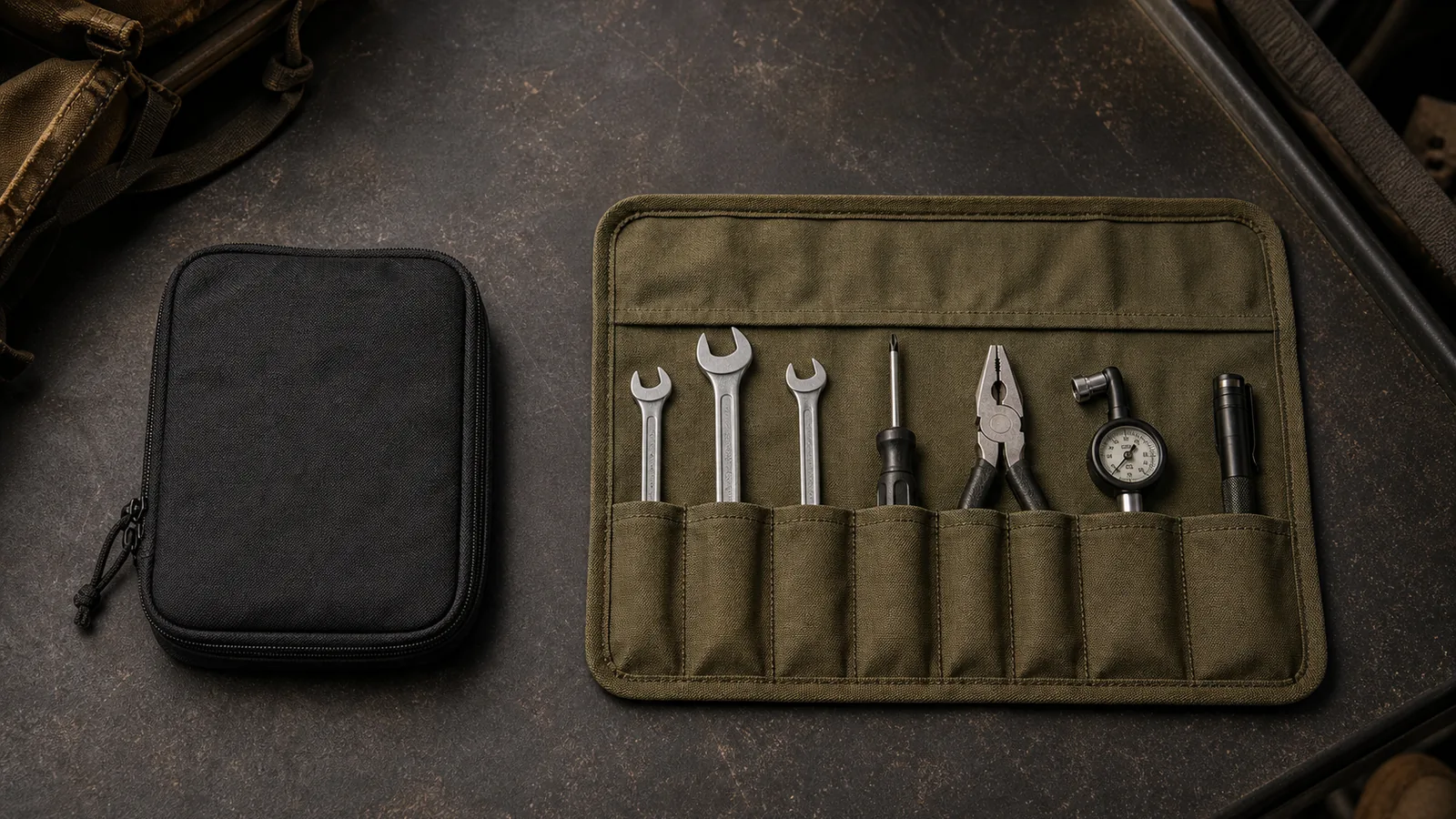
The short answer
An EDC pouch wins on containment and flexibility. A tool roll wins on visibility and a fixed layout. If your kit contains objects in several shapes—charging cable, penlight, gloves, tape, adapters, keys, small containers, or compact pliers—a zippered pouch keeps the group together. If your kit is mainly a known set of wrenches, drivers, picks, or similar long tools, a roll lets you assign one slot to each piece and spot a missing tool quickly.
The decision is not really about which organizer is “better.” It is about whether your load behaves like a mixed pile or a matched set. A pouch turns the mixed pile into one movable module. A roll turns the matched set into a flat visual inventory.
EDC pouch vs. tool roll at a glance
| Question | EDC pouch | Tool roll |
|---|---|---|
| Best load | Small gear in different shapes and thicknesses. | Long, slim, or repeated tools with predictable dimensions. |
| Layout | Enclosed body with pockets, loops, or open space. | Flat panel with individual sleeves, loops, or pockets. |
| Access | Open the zipper and work from one compact module. | Unfasten and unroll it to see the whole set. |
| Missing-item check | Depends on how disciplined the internal layout is. | Strong: an empty slot is usually obvious. |
| Odd-shaped gear | Strong, within the pouch’s depth and zipper limits. | Weak when an item does not match the slot shape. |
| Pack footprint | A compact three-dimensional block. | Flat when open; rolled or folded when stored. |
| Main failure | Becoming an overfilled catch-all that requires digging. | Overstuffing the slots until the roll will not close cleanly. |
What each organizer is designed to do
An EDC pouch contains a category
An everyday-carry pouch is a small enclosed organizer. It normally rides inside a backpack, work bag, vehicle kit, range/camp bag, or larger travel bag. Some models also attach to compatible webbing. Its advantage is freedom: the contents do not all need the same length, thickness, or shape.
That freedom has a cost. If every item is dropped into one main compartment, the pouch can become a “small black hole.” Internal pockets and elastic loops help, but the user still has to give each zone a job. The pouch works best when it owns one clear category instead of every object that might be useful someday.
A tool roll displays a set
A tool roll starts as a flat sheet with sleeves, loops, or pockets. The tools lie across it, then the sheet rolls or folds and closes with a strap, buckle, or zipper. Because the open roll presents the full set at once, it is especially useful when the exact inventory matters.
A current comparison from Lochby reaches the same practical split: flatter, structured items suit a roll, while bulky or differently shaped items gain more freedom in a pouch. The specific products differ, but the shape test is broadly useful.
When an EDC pouch is the better choice
Choose a pouch when the list looks irregular: tire-pressure gauge, charging lead, compact flashlight, work gloves, tape, small fasteners, marker, ear protection, adapter, or compact multi-tool. These items can share one purpose without sharing one shape.
A pouch also makes sense when the same support kit moves between a truck, work bag, garage shelf, and travel bag. You can move one loaded module instead of rebuilding several pockets. For a daily work setup, see our tactical pouch work-bag guide. For a vehicle-focused setup, see the truck-kit organizer guide.
Keep the role narrow enough that the zipper closes without pressure. The moment the pouch becomes a substitute for a full toolbox, it loses the advantage that made it useful: compact grab-and-go organization.
When a tool roll is the better choice
Choose a roll when the load is stable and tool-shaped. A short wrench set, driver set, bike-repair set, carving tools, electrical hand tools, or vehicle-repair basics can be easier to check and use when each piece has a dedicated slot.
The roll is strongest at the work surface. Open it on a bench, tailgate, or clean patch of ground and the layout becomes a checklist. You can reach for a specific piece without moving a pile, and you can scan the empty sleeves before packing up.
Do not force bulky or loose accessories into narrow sleeves. A tape measure, gloves, charging cable, irregular adapter, or box of small parts may distort the roll or fall out when it opens. Those are signals that a pouch—or a second organizer—is the better home.
Which works better in a truck?
For a truck, separate the repair set from the support set. A tool roll can hold the predictable metal tools. A pouch can hold the mixed items you reach for around them: tire gauge, flashlight, gloves, marker, tape, charging lead, spare fuses kept in a suitable container, and other small non-medical essentials.
The National Highway Traffic Safety Administration’s summer driving guidance recommends a roadside kit with items such as a phone and charger, first-aid kit, flashlight, warning devices, jumper cables, tire-pressure gauge, basic repair tools, water, and other supplies. One small pouch cannot and should not replace that complete roadside kit. Use organizers to divide the kit by role, not to reduce the safety equipment to whatever fits in one zipper.
Keep a dedicated first-aid kit clearly identifiable rather than mixing medical supplies among general tools. Jumper cables, warning devices, water, a jack, and other large emergency items need their own safe storage. The pouch-versus-roll choice applies to the small support gear inside the larger vehicle system.
Which works better in a work bag?
For a mixed daily support kit, the pouch usually wins. It can keep a compact light, cable, access keys, marker, tape, small parts, and frequently used accessories away from a laptop, notebook, lunch, or clean clothing. The whole module can move when the outer bag changes.
For a field technician, maker, mechanic, installer, or maintenance role with a stable hand-tool set, the roll may be the better first layer. The visual inventory helps at the end of a task, while the flat opening makes the tools easy to scan. Add a separate pouch only for the loose support pieces that do not belong in the roll.
Tool storage does not make damaged or unsuitable tools safe. The Occupational Safety and Health Administration’s Hand and Power Tools guide says tools should be kept in good condition, the right tool should be used for the job, and tools should be examined for damage before use. Treat organization as a way to support those habits—not as a replacement for inspection, training, or protective equipment.
The hybrid setup: one roll, one pouch
Many practical kits are easier to manage as two modules:
- Tool roll: the fixed set—wrenches, drivers, picks, or other slim hand tools.
- EDC pouch: the support set—flashlight, gauge, gloves, tape, cable, small containers, and odd-shaped accessories.
This split prevents small items from disappearing between heavier tools. It also gives each module a clear reset rule. The roll is complete when every assigned slot is filled. The pouch is complete when its short checklist is present and the zipper closes without forcing it.
If you are considering several organizer styles, our EDC pouch vs. tech pouch and EDC pouch vs. sling bag guides cover two different carry decisions.
A five-minute decision test
- Lay out the real load: use the items you actually carry, not a wish list.
- Sort by shape: place long, slim tools in one group and mixed-shape support gear in another.
- Count fixed tools: if every tool deserves a repeatable slot, a roll has a clear advantage.
- Check the largest item: measure the longest and thickest pieces before choosing either organizer.
- Mark access frequency: gear used several times a day should not sit beneath rarely used backups.
- Simulate the work surface: decide whether you normally open the kit on a bench or reach into it while standing.
- Leave closing space: both formats need enough room to close without stressing seams, sleeves, or zippers.
- Reset the kit: put every item back once. The easier reset is usually the better long-term system.
Where the CobaltNook pouch fits
The current CobaltNook Tactical MOLLE Organizer Pouches are built for the pouch side of this comparison. The product page describes a main compartment, front zip pockets, and MOLLE organization for small gear such as chargers, keys, flashlights, compact tools, and first-aid basics. They are organizers for support gear, not replacements for a full-size tool roll, toolbox, or complete roadside emergency kit.
The current core loadout includes two pouches in one selected color plus two US flag patches. A four-pouch full loadout is also available for separate carry zones. Current color choices are Black, ACU, Khaki, and Green. One practical split is a truck support pouch plus a work-bag pouch, while the actual hand-tool set stays in a dedicated roll or toolbox.
If “MOLLE pouch” and “EDC pouch” sound interchangeable, read our MOLLE pouch vs. EDC pouch guide. MOLLE describes an attachment system; EDC describes how the organizer is used.
Common mistakes to avoid
- Choosing by capacity alone: usable layout matters more than the largest claimed volume.
- Turning a pouch into a junk drawer: one compact organizer still needs categories and reset rules.
- Using a roll for loose pieces: small parts need secure containers, not oversized open sleeves.
- Forcing closures: stressed zippers and straps are signs that the load needs editing or a larger system.
- Mixing medical and general gear: first-aid supplies should remain clearly identified and easy to find.
- Skipping a real-load test: product photos cannot tell you whether your longest and thickest items fit.
- Ignoring tool condition: neat storage does not make a damaged tool suitable for use.
Frequently asked questions
Is an EDC pouch the same as a tool roll?
No. An EDC pouch is an enclosed organizer for small gear in different shapes. A tool roll is a flat organizer with individual slots that rolls or folds closed around a defined set of tools.
Which is better for a truck tool kit?
Use a tool roll for a matched set of wrenches, drivers, or other long tools. Use an EDC pouch for a tire gauge, gloves, flashlight, charging cable, tape, compact pliers, and other mixed-shape support gear. A two-part setup often works best.
Which is better inside a work bag?
An EDC pouch is usually better for a mixed daily support kit because it contains loose accessories and moves easily between bags. A tool roll is better when the work bag carries a stable set of slim hand tools.
Can you use an EDC pouch and tool roll together?
Yes. Put the fixed tool set in the roll and the loose support items in the pouch. Keeping the roles separate makes it easier to see what is missing and prevents small items from getting buried among metal tools.
Bottom line
Choose the EDC pouch when the gear shares a purpose but not a shape. Choose the tool roll when the gear is a repeatable set of long or flat tools. In a truck or work bag, the best system is often a roll for the fixed hand tools and a pouch for the odd-shaped support items. Keep both loads disciplined, inspect tools before use, and let the complete roadside or workplace safety plan stay larger than either organizer.