The short answer
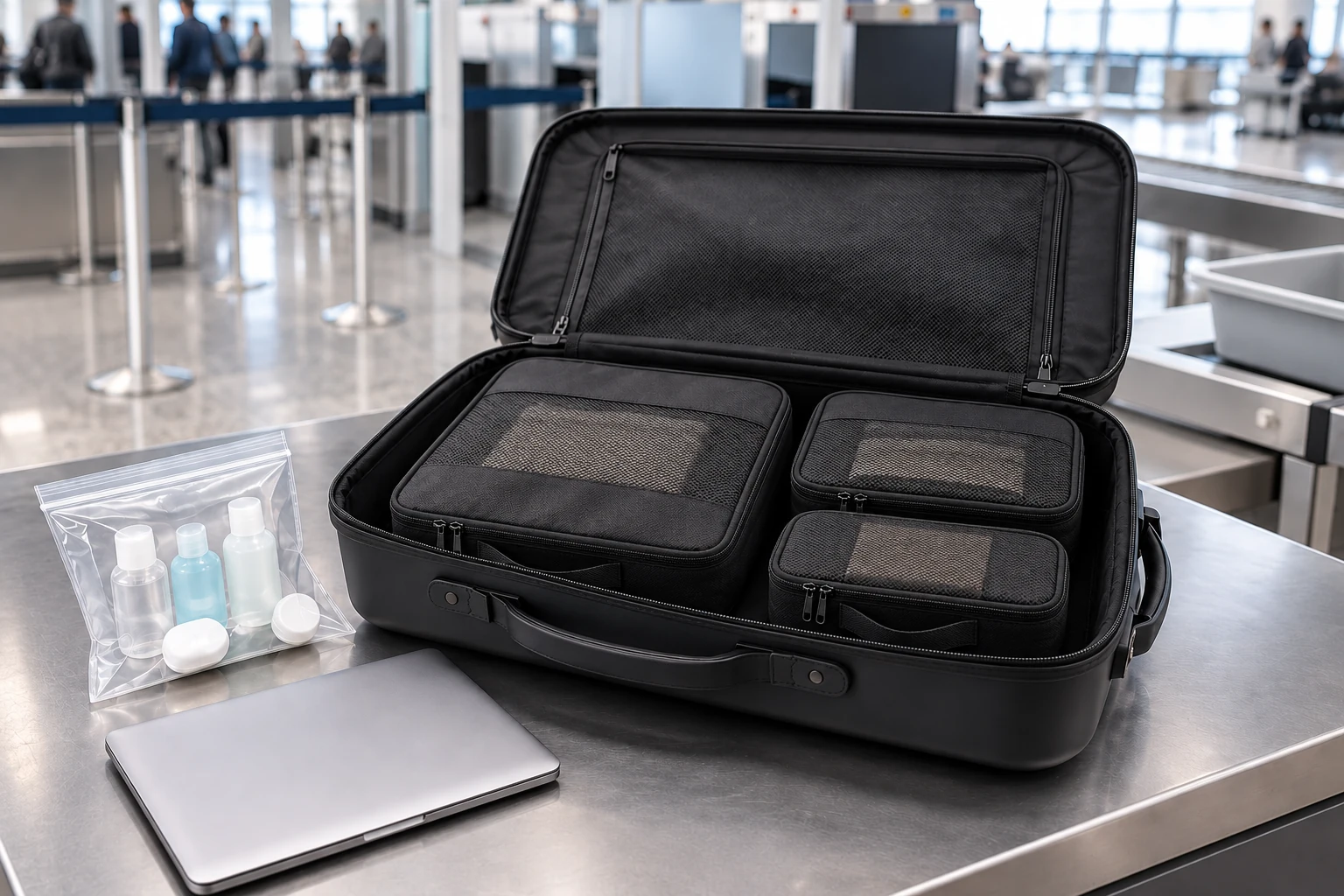
Leave normal clothing packing cubes inside your bag unless a TSA officer tells you otherwise. The TSA's current instructions for standard screening lanes specifically call for personal electronic devices larger than a cell phone to be removed and placed in a bin. TSA also says officers may ask travelers to separate food, powders, or other materials that clutter a bag and obstruct a clear X-ray image. Packing cubes themselves are not named as a routine removal item.
That distinction matters. A packing cube does not receive special approval, and it does not protect its contents from screening rules. It is simply a fabric organizer. If a cube contains only shirts, underwear, socks, or other ordinary clothing, it can generally remain where it is. If it hides a laptop, a liquids bag, dense food, tools, batteries, or another item that needs attention, the officer may ask you to remove or open it.
Airport equipment and instructions can vary. TSA says its processes may change and an officer will guide you through the lane. Listen to the instructions at the actual checkpoint even if your last airport handled the same bag differently.
What comes out—and what normally stays in
| Item | Standard screening lane | Best packing decision |
|---|---|---|
| Clothing packing cubes | Usually stay inside the carry-on unless an officer asks otherwise. | Use them for soft clothing and avoid hiding items that may need separate screening. |
| Laptop, tablet, e-reader, handheld game console | TSA says personal electronics larger than a cell phone must be removed and placed in a bin with nothing above or below them. | Keep the device near the top of the bag, outside a tightly packed clothing cube. |
| 3-1-1 liquids bag | Separate it from the carry-on in a standard lane so it can be screened. | Place it in an accessible pocket or at the top of the bag rather than under the cubes. |
| Food, powders, or cluttered materials | An officer may ask you to separate them if they obstruct a clear image. | Keep dense or unusual items together and reachable. |
| TSA PreCheck items | Members generally leave approved electronics and 3-1-1 liquids in the bag, but no traveler is guaranteed expedited screening. | Still pack accessibly because additional instructions can happen. |
These are U.S. TSA procedures. Airports outside the United States follow their own security authority's rules. On an international trip, check the departure airport rather than assuming the U.S. process applies everywhere.
When TSA may open a packing cube
TSA screens all carry-on baggage, and screening sometimes leads to a physical inspection. A cube may be opened when an item alarms, when the X-ray image is not clear enough, or when the officer needs to identify something inside. That does not mean packing cubes are prohibited. It means the contents still need to be screened.
TSA's What Can I Bring? guide says even a generally permitted item may receive additional screening or be refused if it triggers an alarm, appears tampered with, or creates another security concern. It also makes clear that the final checkpoint decision rests with the TSA officer.
Pack each cube so it can be opened without a clothing explosion. Close zippers fully, avoid wrapping a cube with cords or straps, and do not force the cube until its zipper is under heavy tension. If an officer needs to look inside, a simple category—such as “shirts” or “underwear and socks”—is easier to inspect and repack than a dense mix of clothing, chargers, food, toiletries, and tools.
Are there “TSA-approved” packing cubes?
There is no useful TSA-approval label to look for on an ordinary clothing cube. TSA publishes rules for what can travel in carry-on and checked baggage and explains what passengers should separate during screening. It does not maintain a special approval program for fabric packing cubes.
Clear or mesh panels may help you identify the contents quickly, but they do not create a security exemption. Compression zippers can reduce clothing volume, but they do not change screening rules or remove weight. Choose a cube for fit, durability, visibility, and easy opening—not because a seller uses vague “TSA-friendly” wording.
The current CobaltNook gear page lists an 8-set packing cube system for carry-ons, checked bags, weekend duffels, and family travel. You do not need to use all eight pieces in one bag. Our guide to how many packing cubes fit a carry-on recommends starting with the fewest pieces that create useful clothing zones.
How to pack cubes for a smoother checkpoint
- Use cubes mainly for clothing. Shirts, pants, underwear, socks, sleepwear, and soft layers create predictable groups.
- Keep large electronics accessible. In a standard TSA lane, devices larger than a cell phone need to come out. A laptop sleeve near the back panel or top of the carry-on is easier than a device buried under three cubes.
- Keep the liquids bag separate. TSA's 3-1-1 liquids rule allows one quart-size bag with containers of 3.4 ounces or 100 milliliters or less per item. Place that bag where you can reach it before the conveyor.
- Do not create one dense mystery block. Split very heavy clothing across two cubes when one becomes unusually hard, thick, or difficult to open. TSA specifically recommends keeping bags organized rather than jam-packed and overstuffed.
- Check unusual items before leaving home. Use TSA's item database for tools, batteries, sports equipment, food, medication, and other items that are not ordinary clothing.
- Follow the lane, not a memorized script. Newer equipment, TSA PreCheck, and local procedures can change what stays in the bag. The officer's current instruction wins.
Do compression packing cubes cause TSA problems?
Compression cubes are not automatically a problem. Their main risk is practical: travelers sometimes pack them so tightly that the bag becomes dense, difficult to inspect, or hard to close again after a check. TSA warns that jam-packed, cluttered, overstuffed bags take more time to clear because officers need a readable image.
Use the compression zipper to remove loose volume, not to turn several heavy garments into a rigid brick. Keep cords, chargers, batteries, food, and toiletries out of the clothing layer when possible. If you are deciding between formats, our regular vs. compression packing cubes guide explains the organization and space tradeoff.
What changes with TSA PreCheck?
TSA says PreCheck travelers generally leave electronics and their 3-1-1 liquids in the bag and keep on shoes, belts, and light jackets. Your packing cubes can stay inside as well. However, TSA also states that it uses unpredictable security measures and no individual is guaranteed expedited screening.
Pack for easy access even when your boarding pass shows TSA PreCheck. A lane can be closed, an item can require more screening, or an officer can give different instructions. Accessible packing is not wasted space; it prevents a small change from turning into a full unpack at the checkpoint.
What about packing cubes in checked luggage?
Packing cubes can stay inside checked luggage. TSA says most checked bags are screened without a physical search, but officers may inspect a bag and place an inspection notice inside when they do. Use cubes that open easily and avoid packing restricted or dangerous items just because the bag is checked.
Carry-on and checked-bag rules are not identical. The FAA's PackSafe guide explains that many hazardous materials are forbidden and that some permitted personal items have specific conditions. TSA security rules and FAA dangerous-goods rules are separate, so check both when packing batteries, aerosols, fuel, or other regulated items.
A simple airport-ready carry-on layout
- Bottom or wheel end: shoes in a bag, then the heaviest clothing cube.
- Middle: one or two clothing cubes arranged so their zippers face up.
- Top: jacket, first-night clothing, or another soft item you may need quickly.
- Laptop area: dedicated sleeve or flat top layer with a clear path out.
- Accessible pocket: liquids bag, medication that needs separate handling, and other screening-ready items.
- Personal item: ID, phone, wallet, charging cable, medication, and in-flight essentials—never buried in checked luggage.
This builds on our broader packing cube carry-on setup. If you also use a small gear organizer, see the packing cubes vs. EDC pouch guide so clothing and quick-access items do not compete for the same space.
Frequently asked questions
Do packing cubes need to come out at TSA?
Usually no. Leave ordinary clothing cubes in your carry-on unless an officer asks you to separate or open them. Keep a laptop, liquids bag, and other items that may need separate screening easy to reach.
Are packing cubes TSA approved?
TSA does not publish a special approval category for packing cubes. The organizer is normally allowed, but each item inside must follow current TSA, FAA, airline, and destination rules.
Does TSA go through packing cubes?
It can. TSA may open a cube during a physical inspection if something alarms, blocks a clear image, or needs identification. Pack simple categories and avoid overstuffing so the cube is easy to open and close.
Do I remove packing cubes at an international airport?
Follow the rules of the country and airport where you are departing. U.S. TSA guidance does not control every international checkpoint, and local officers may use different equipment or instructions.
Bottom line
Packing cubes usually stay inside your carry-on at TSA. Use them for normal clothing, keep large electronics and the liquids bag accessible, and never treat the cube as an exemption for the items inside. A simple, not-overstuffed layout makes both X-ray screening and any manual inspection easier.
Before every trip, check the TSA page for unusual items and listen to the officer at the actual lane. For the clothing side of the setup, choose the CobaltNook packing cube pieces that fit your bag and leave enough room to remove screening items without dismantling the suitcase.
Sources and further reading
- TSA: Security Screening — current standard-lane guidance for electronics, food, packing, and items that may need to be separated.
- TSA: Liquids, Aerosols, and Gels Rule — official 3-1-1 limits and separate-screening guidance.
- TSA: What Can I Bring? — official item lookup, additional-screening note, and final-officer-decision statement.
- TSA PreCheck — current guidance on electronics and liquids remaining in the bag, plus the warning that expedited screening is not guaranteed.
- FAA: PackSafe for Passengers — official dangerous-goods guidance and the distinction between FAA safety rules and TSA security rules.