The short answer
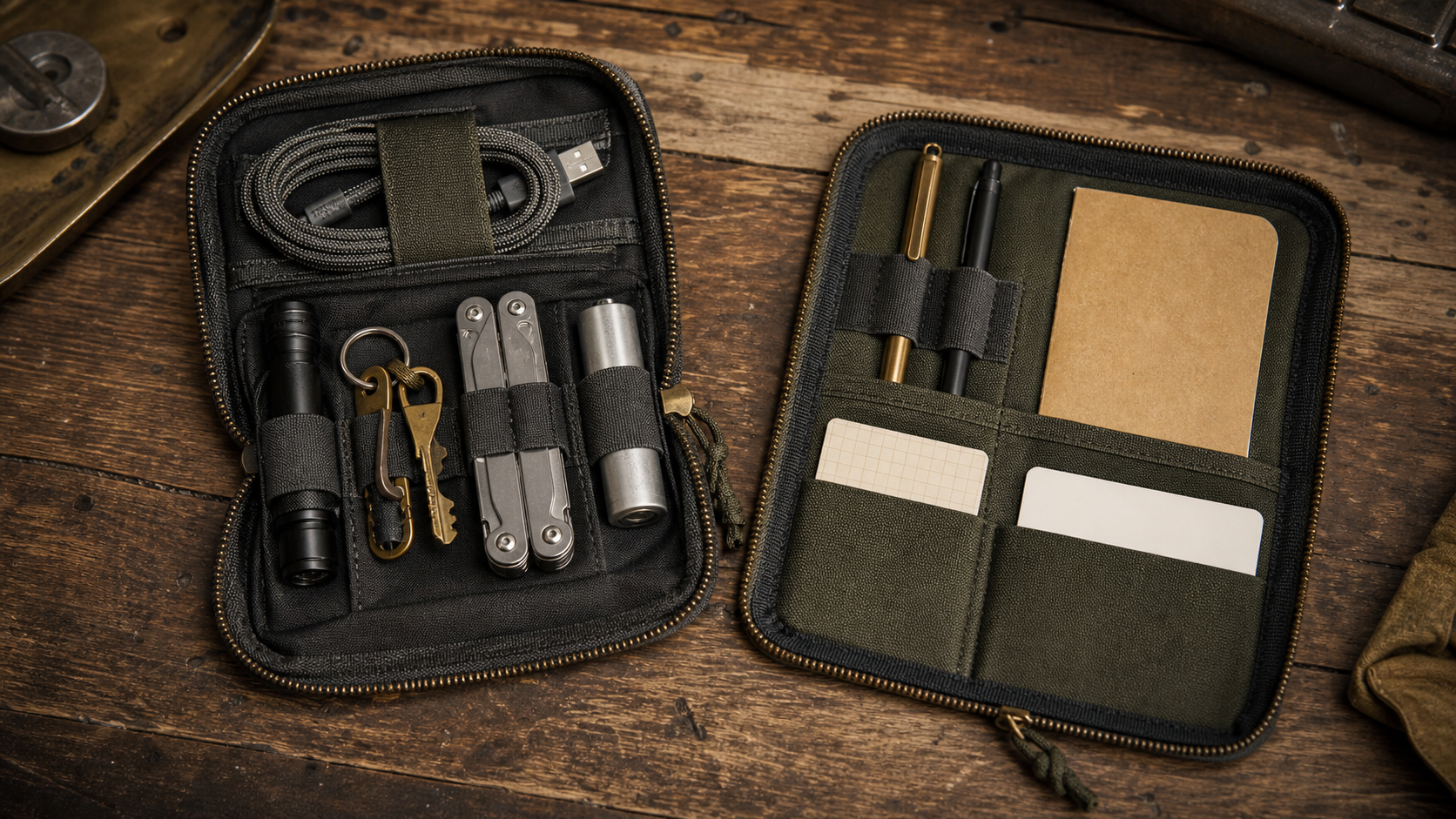
An EDC pouch is the broader category. An admin pouch is usually a more specialized organizer for flat, frequently accessed items. Use an EDC pouch for a mixed load such as a charging cable, compact flashlight, keys, adapter, battery, gloves, or small multi-tool. Use an admin pouch when the core load is a notebook, pens, cards, folded reference material, identification, or other slim items that benefit from visible, assigned slots.
The important word is usually. Brands do not use these names consistently. Some call almost any small organizer an admin pouch. Others reserve the term for a slim pouch that mounts to compatible webbing and keeps writing or reference tools at hand. That makes a feature-by-feature comparison more useful than a category label.
EDC pouch vs. admin pouch at a glance
| Question | General EDC pouch | Admin pouch |
|---|---|---|
| Primary job | Contain a mixed set of everyday tools and accessories. | Organize slim, frequently used writing, identity, and reference items. |
| Typical contents | Cable, flashlight, keys, compact tool, adapter, battery, tape, or gloves. | Pens, notebook, cards, folded documents, map or reference sheet, and small tools. |
| Shape | Often deeper, with room for items of different thicknesses. | Often flatter, with dedicated sleeves or loops. |
| Access pattern | Open one portable module and work from its pockets or main compartment. | Reach repeatedly for a few assigned items without digging. |
| Mounting | May ride inside a bag, vehicle kit, drawer, or compatible webbing setup. | Often designed around a fixed or mounted position, but not always. |
| Best test | Does the pouch hold the whole mixed category without becoming a catch-all? | Can you reach the flat essentials quickly and see what is missing? |
| Main mistake | Buying a large pouch and filling it with unrelated clutter. | Buying a tactical-looking label without checking the actual internal layout. |
Why the names are confusing
“EDC” describes a use: the everyday items a person chooses to keep available. It does not specify one pouch shape. A small clamshell organizer, a zip pouch with elastic loops, or a slim pocket module can all be sold for everyday carry.
“Admin pouch” points more strongly toward a layout and access job. In a current first-party guide, Midwest Armor describes an admin pouch as a small organizer commonly mounted on a carrier, chest rig, or belt, with examples that include pen slots, a flat document compartment, and a main compartment. That is one maker’s category definition, not a universal standard, but it explains why admin pouches often look flatter and more structured than general utility organizers.
NutSac’s admin-pouch guide applies the idea to everyday use and emphasizes repeated access to items such as a phone, flashlight, medicine, headphones, pens, and notebooks. Its own slim and larger products differ considerably, which is another reminder that “admin pouch” does not guarantee one capacity or pocket map.
The practical conclusion is simple: treat the product name as a starting point. Confirm the opening angle, usable depth, pocket dimensions, loop sizes, mounting method, and closure before buying.
What a general EDC pouch does well
A general EDC pouch turns several loose objects into one movable module. That is useful when the same support kit moves between a work bag, truck, garage shelf, travel bag, or larger outdoor pack. Instead of assigning every outer-bag pocket again, you move the loaded pouch.
It also handles shape variety. A flashlight is round, a charging cable flexes, keys are irregular, and a compact tool may be thick. A pouch with some depth and a mix of loops, pockets, and open space can contain them together. Our beginner’s guide to EDC pouches explains the broader category and how to keep a small organizer from becoming a junk drawer.
The weakness is also flexibility. If the pouch has no clear zones, frequently used items sink beneath rarely used backups. A good setup gives the main compartment one purpose, uses loops for items that should not move, and leaves enough room to close the zipper without force.
What an admin pouch does well
An admin pouch is strongest when the load is slim, predictable, and accessed often. Pens need narrow loops. A notebook or folded reference card benefits from a flat sleeve. Identification, vehicle documents, job cards, or a small checklist are easier to find when they do not share a deep compartment with cables and tools.
Many admin-style layouts are designed to stay in a repeatable position on a bag, panel, belt, or compatible webbing. That can make one-handed or glanceable access easier, but mounting is not mandatory for civilian use. A flat admin module can sit inside a backpack just as easily if that is where the user needs it.
Its limitation is bulky gear. Thick chargers, gloves, a large multi-tool, or several round objects can distort a slim layout and block access to the very items the pouch was meant to present. If the real load is mostly irregular hardware, use a general EDC pouch instead of forcing the contents into an admin-shaped shell.
A six-step decision test
- Lay out the actual load. Do not shop from a wish list. Put the items you carried during the last week on a table.
- Separate flat from bulky. Pens, cards, documents, and a notebook form an admin-style group. Cables, keys, lights, adapters, and compact tools form a general EDC group.
- Mark access frequency. Circle the items reached for several times a day. They need the simplest path, not the largest pocket.
- Choose the carry position. Decide whether the organizer will live inside a work bag, on compatible webbing, in a truck console, or on a garage shelf.
- Measure the largest pieces. Product photos can hide depth. Check the longest, thickest, and most rigid items against usable pocket space.
- Run a reset test. Remove every item and pack it again. The layout that makes missing items obvious and resets without forcing the closure is the better system.
Which works better in a work bag?
For most mixed work-bag support kits, a general EDC pouch is the easier choice. It can group a charging cable, adapter, compact light, access keys, marker, small tool, and spare battery away from a laptop, lunch, or clean clothing. See our work-bag EDC setup for a practical category-based loadout.
An admin pouch is better when the daily job revolves around notes and reference material: notebook, pens, ID, business cards, service checklist, folded instructions, or other flat items. A technician or supervisor may use an admin pouch for the information layer and a separate EDC pouch for cables and tools.
Do not treat either organizer as a laptop protector, hard case, or substitute for job-specific safety equipment. Its job is small-item access and containment.
Which works better in a truck or vehicle kit?
A general EDC pouch works well for mixed support gear that would otherwise rattle through a console or larger emergency bin. A compact flashlight, charging lead, tire gauge, gloves, marker, tape, and small adapters can share one clearly labelled role. Our truck-kit pouch guide covers that broader setup.
An admin pouch can handle the flat vehicle-information layer: pen, small notebook, roadside membership card, printed emergency contacts, or maintenance notes. Keep registration, insurance, and other sensitive documents in a secure location appropriate to local rules and personal risk; a visible external pouch is not automatically the right place.
Neither organizer replaces a complete roadside kit. Large safety items need their own secure storage, and medical supplies should remain clearly identified rather than mixed into general gear. The EDC pouch vs. first-aid kit guide explains that separation.
Which works better for travel?
A general EDC pouch is usually better for a compact travel support kit: cable, charger, plug adapter, penlight, keys, earplugs, and small non-liquid accessories. Keep airport and airline restrictions in mind; the organizer does not make a prohibited item acceptable. For the security-screening angle, read our TSA-friendly EDC pouch guide.
An admin pouch can be useful for flat trip information such as a notebook, pens, cards, and printed backup details. Keep passports, payment cards, and personal records under direct control rather than assuming a mounted or externally accessible pouch is secure.
Five layout details that matter more than the label
- Opening style: a full clamshell shows more contents; a top zip can be quicker for a short list.
- Usable depth: thick items need real space after the internal dividers are loaded.
- Loop sizes: pen loops and flashlight loops are not interchangeable just because both are elastic.
- Flat sleeves: useful for cards and notes, but easy to block with bulky objects in front.
- Mounting method: confirm compatibility instead of assuming every webbing panel and strap arrangement works together.
If the difference between MOLLE and EDC is still unclear, our MOLLE pouch vs. EDC pouch comparison separates attachment method from everyday use.
Where the CobaltNook pouch fits
The current CobaltNook Tactical EDC Pouch is positioned on the general-organizer side of this comparison. The current gear page describes a two-pouch set with MOLLE webbing and use cases that include cables, chargers, keys, flashlights, first-aid basics, and small tools. That mixed-shape list is broader than a dedicated pen-and-document admin layout.
The two-pouch format makes role separation practical. One pouch can own work-bag electronics and access items while the other owns truck or garage support gear. The current set also includes two US flag patches. Those are product-page facts, not a claim that every item shown or mentioned will fit; check the real load and current product details before ordering.
Could one of these pouches serve as an admin pouch? It can organize some admin-type items if its pockets and loops suit the load, but it is more accurate to call it a modular EDC organizer than a dedicated slim admin pouch. Buyers who mainly carry pens, cards, and a notebook should compare those item dimensions and layout needs first.
When two organizers are better than one
A hybrid setup avoids forcing two jobs into one pouch:
- Admin module: notebook, pens, cards, reference sheet, and other flat frequent-access items.
- General EDC module: cable, compact light, keys, adapter, battery, tape, gloves, and small tools.
This split is useful in a truck, field bag, or work backpack. The admin module stays clean and quick to scan. The general pouch contains the irregular objects. Each module gets a short reset checklist, and neither has to become oversized.
Common mistakes to avoid
- Assuming the category name is standardized: read the pocket map and dimensions.
- Buying for imagined gear: use the items already carried during a normal week.
- Mixing flat documents with bulky hardware: thick objects can block admin-style access.
- Choosing capacity over access: a larger pouch can create more digging, not less.
- Forcing the closure: pressure on the zipper is a sign to edit the load or split the role.
- Ignoring security: quick access also means quick exposure; protect sensitive cards and documents.
- Mixing medical and general gear: keep a dedicated first-aid kit clearly identified.
Frequently asked questions
Is an admin pouch the same as an EDC pouch?
Not always. EDC pouch is a broad term for a portable everyday-gear organizer. Admin pouch usually describes a more specific layout for flat, frequently used items such as pens, a notebook, cards, or reference material. Sellers use the labels differently, so compare the actual layout.
Can an EDC pouch be used as an admin pouch?
Yes, if its layout matches the job. Look for pen loops, a flat sleeve, controlled opening, and quick access to the items you use most. A deep pouch with only one open compartment may work for general EDC but poorly as an admin organizer.
Is an admin pouch only for tactical gear?
No. The format comes from field and tactical organization, but the same flat, quick-access layout can work for a work bag, vehicle document kit, travel document set, or notebook-and-pen module.
Which is better for a work bag?
A general EDC pouch is usually better for mixed items such as cables, keys, a flashlight, adapters, and a compact tool. An admin pouch is better when the load is mainly a notebook, pens, cards, documents, and other flat items you reach for repeatedly.
Bottom line
Choose by load and access pattern. A general EDC pouch is the better default for mixed everyday gear in several shapes. An admin pouch is the better fit for flat, frequently used writing, identity, and reference items. Because the labels overlap, the winning organizer is the one whose real pockets, depth, opening, and mounting method match the objects you actually carry.
For a mixed work, truck, or travel support kit, start with the CobaltNook Tactical EDC Pouch 2-Pack and give each pouch one clear job.
Sources and further reading
- Midwest Armor: Admin Pouch Guide — first-party maker explanation of common admin-pouch layouts, contents, sizes, and mounting positions.
- NutSac: A Guide to Admin Pouches — first-party maker explanation of frequent-access everyday use and slim versus larger layouts.
- CobaltNook current gear page — current CobaltNook set contents and stated pouch use cases checked before publication.