The short answer
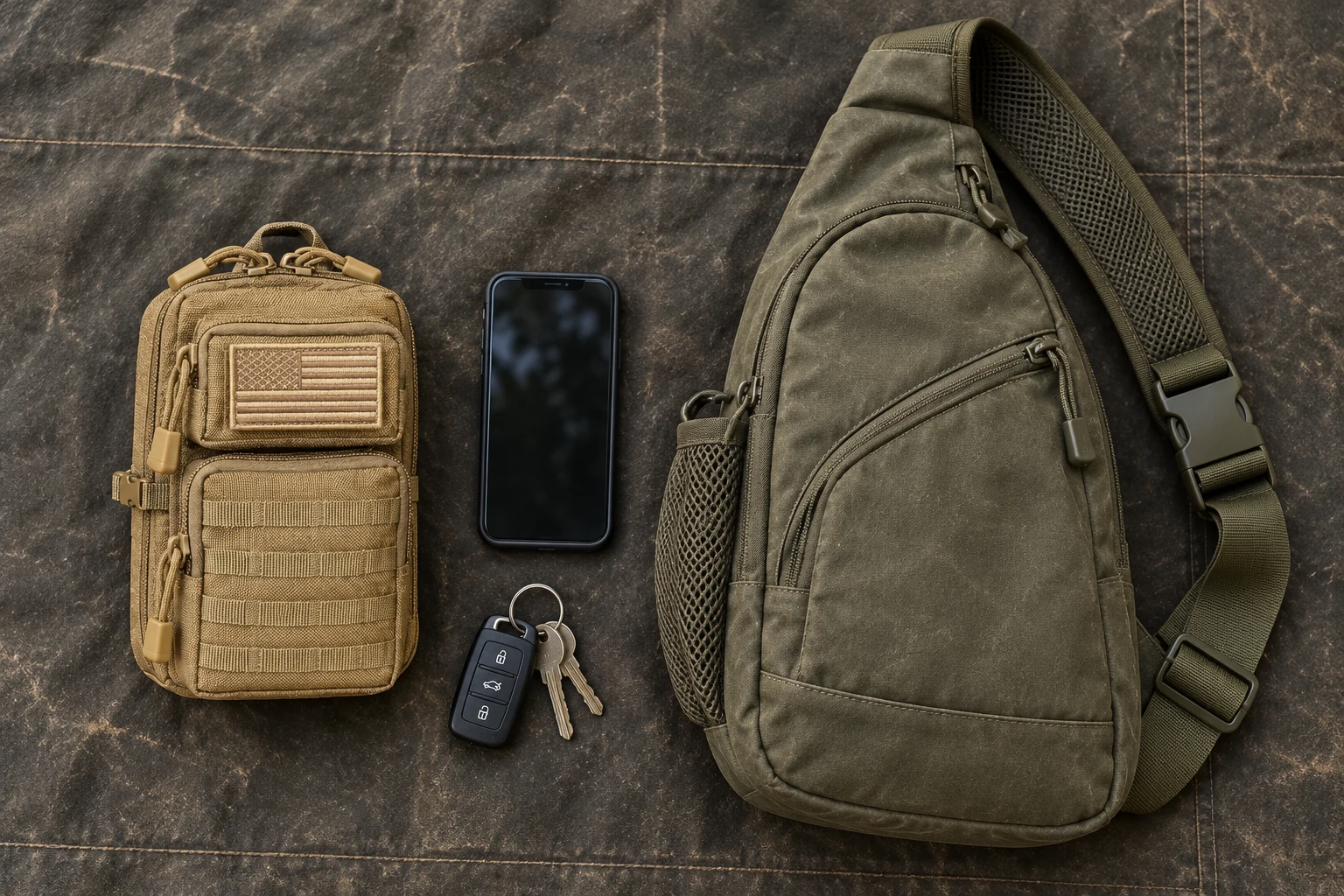
An EDC pouch is best for modular organization. A sling bag is best for lightweight, hands-free carry. A pouch gives cables, keys, a flashlight, a power bank, and other small essentials one fixed home. It normally rides inside a backpack, briefcase, work bag, truck kit, or larger travel bag. A sling has its own strap, sits on your chest, back, or hip, and can carry those essentials without a larger bag.
If your main frustration is loose items collecting at the bottom of a bag, start with a pouch. If your main frustration is overfilled pockets or carrying a full backpack for a few items, start with a sling. If you use several bags during the week, a pouch can become the transferable module that moves between them.
EDC pouch vs. sling bag at a glance
| Question | EDC pouch | Sling bag |
|---|---|---|
| Primary job | Organize small gear as one removable module. | Carry a small daily load on your body. |
| How it carries | Inside a larger bag, in a vehicle, by hand, or on compatible webbing. | Across the chest, back, or hip with its own shoulder strap. |
| Best capacity | Cables, charger, keys, flashlight, compact tools, small first-aid basics, and other loose essentials. | Phone, wallet, sunglasses, charger, passport, small notebook, and other items that outgrow pockets. |
| Quick access | Fast once the pouch is out, but slower when it is buried inside another bag. | Usually easier to swing forward and open while standing or walking. |
| Switching bags | Strong: move the loaded pouch from work bag to travel bag or vehicle. | Not needed in the same way because the sling is the bag. |
| Main mistake | Overloading it until it becomes a dense catch-all. | Choosing too much capacity and turning it into an uncomfortable one-strap backpack. |
When an EDC pouch is the better choice
Choose a pouch when you already like the bag you carry but dislike its loose interior. A pouch adds structure without replacing the backpack, briefcase, messenger bag, range/camp bag, or vehicle kit around it. Instead of searching several pockets, you pull out one module and see the small items together.
This is especially useful for a repeated category. A charging pouch can hold a cable, wall adapter, compact power bank, and earbuds. A work module can hold keys, a pen, small flashlight, access card, and frequently used accessories. A truck module can keep a tire gauge, charging lead, gloves, and other non-medical basics separate from the dedicated first-aid kit. Our work-bag pouch guide and truck-kit setup show those roles in more detail.
Heinnie Haynes’ current pocket, pouch, and bag carry guide recommends matching the carry method to the environment, clothing, and access speed each item requires. That is a useful test: items you need occasionally can stay in a pouch inside the main bag, while items you reach for constantly should sit closer to hand.
When a sling bag is the better choice
Choose a sling when the load is too large for comfortable pockets but too small to justify a backpack. A sling is a small wearable bag, not merely an organizer. The strap and body position matter as much as the internal pockets because you carry its full weight on one shoulder or across the torso.
Carryology’s beginner’s guide to sling bags describes the format as a crossbody bag worn over one shoulder, designed around a compact set of essentials. Pack Hacker’s updated sling-bag guide compares size, profile, materials, comfort, access, closures, and internal layout. Those factors explain why a good sling decision starts with the exact load rather than a style alone.
A sling earns its place on city walks, short errands, event days, and light commutes when you want your phone, wallet, sunglasses, keys, and charger off your pockets. It also gives quick access while standing: many slings can rotate from back to chest without being removed. But extra space invites extra weight. If you regularly add a laptop, large bottle, jacket, and bulky camera kit, a two-strap backpack is usually the more sensible category.
Which one works better for a work bag?
If you already carry a laptop bag or backpack, the pouch wins. It uses space you already have, prevents small gear from mixing with documents and electronics, and lets you transfer the same support kit between bags. Give the pouch one job and keep the laptop, water bottle, and larger notebook in the main bag.
If your workday only needs a phone, wallet, keys, access card, compact charger, and small notebook, a sling may replace the larger bag. Check that the longest and thickest item fits without bowing the zipper, and make sure the strap feels stable with the real load—not just an empty bag in a product photo.
A tech-heavy office setup may also call for a dedicated tech organizer rather than a general-purpose pouch. See the EDC pouch vs. tech pouch comparison before choosing a layout.
Which one works better for travel?
For travel, think in layers. A pouch belongs inside the luggage system. It can organize chargers, adapters, small comfort items, or a compact daily kit inside a personal item or carry-on. A sling belongs on the traveler. It can hold items needed while moving, such as a phone, wallet, passport, glasses, and charger.
A pouch is easier to transfer when the trip includes several bags. Move it from a carry-on to a daypack without rebuilding the small-item setup. The personal-item pouch guide shows how to keep it accessible without crowding the main compartment.
A sling can be convenient at the airport and destination, but it may count as a separate personal item depending on the airline and how it is carried. Check the airline’s current bag allowance. Also check the contents, not only the container: the TSA’s official What Can I Bring? directory is the right place to verify individual items before a US flight. Our TSA-friendly EDC pouch guide explains the container-versus-contents distinction.
Can you use a pouch inside a sling?
Yes, but the pouch must earn the space. A small charging pouch inside a larger sling can make sense when it keeps cables and a power bank from tangling with glasses, a passport, or a camera. It also lets you remove the entire charging kit at a hotel or desk.
The setup fails when the organizer duplicates the sling’s built-in pockets or consumes most of its capacity. Before combining them, load the sling without the pouch. If every small item already has a secure, easy-to-find pocket, another layer adds bulk. If the sling is one open compartment and the smallest items sink to the bottom, a narrow-purpose pouch adds value.
A simple decision test
- List the real items: empty your pockets and current bag. Remove “just in case” gear you have not used in months.
- Mark the access items: phone, wallet, keys, transit card, and glasses usually need quicker access than a spare cable or backup battery.
- Choose the outer carry: if you already need a laptop bag, use a pouch inside it. If the whole load is small, test a sling.
- Give every pocket a job: loose categories become clutter even in an organizer.
- Walk with the full load: a sling that looks compact can still feel awkward when overloaded.
- Leave reset space: the zipper should close without forcing items into a single dense block.
Where the CobaltNook pouch fits
The current CobaltNook Tactical EDC Pouch is sold as a 2-pack. Each pack includes two MOLLE organizer pouches in the selected color plus two US flag patches. The pouches use a main zip body, front zip pockets, and MOLLE webbing and are offered in Black, ACU, Green, and Khaki.
That makes it the pouch side of this comparison, not a sling replacement. Use one pouch for a work-bag or travel module and the second for a truck, range/camp, garage, or backup setup. Pack your own essentials and keep medical supplies in a clearly identified dedicated kit when quick recognition matters. For the attachment-versus-use distinction, read MOLLE pouch vs. EDC pouch.
Common mistakes to avoid
- Choosing by volume alone: the internal shape, pocket layout, and opening determine whether the gear is actually usable.
- Treating a pouch as a tiny backpack: if it must carry large daily items, you need a wearable bag.
- Treating a sling as unlimited: one-strap carry rewards a disciplined load.
- Burying quick-access gear: the most frequently used items should not sit under three zippers.
- Mixing every category: cables, tools, snacks, and medical supplies are easier to manage when their roles stay clear.
- Buying before testing the load: arrange the actual items on a table and measure the longest, thickest pieces first.
Frequently asked questions
Is an EDC pouch the same as a sling bag?
No. An EDC pouch is mainly an organizer that goes inside a larger bag, attaches to compatible webbing, or moves between setups. A sling bag has its own shoulder strap and is designed to be worn.
Which is better for commuting: an EDC pouch or a sling bag?
Use a pouch if you already commute with a backpack, briefcase, or work bag and want one movable module for small gear. Use a sling if you want a lightweight hands-free bag without carrying a larger bag.
Can you put an EDC pouch inside a sling bag?
Yes, if the sling is large enough and the pouch does not consume the space needed for larger items. This layered setup works best when the pouch has a narrow job, such as cables and charging gear.
Which is better for travel?
A sling is better for quick-access items you want on your body while moving. A pouch is better for organizing small gear inside a personal item or carry-on and transferring that kit between bags.
Bottom line
Choose an EDC pouch to organize a bag you already carry. Choose a sling bag when you want the organizer to become the bag. The pouch is the better modular tool for work bags, backpacks, vehicle kits, and transferable travel setups. The sling is the better lightweight outer carry for errands, commutes, and quick-access travel essentials. If you combine them, keep the pouch small and give it one clear job.