The short answer
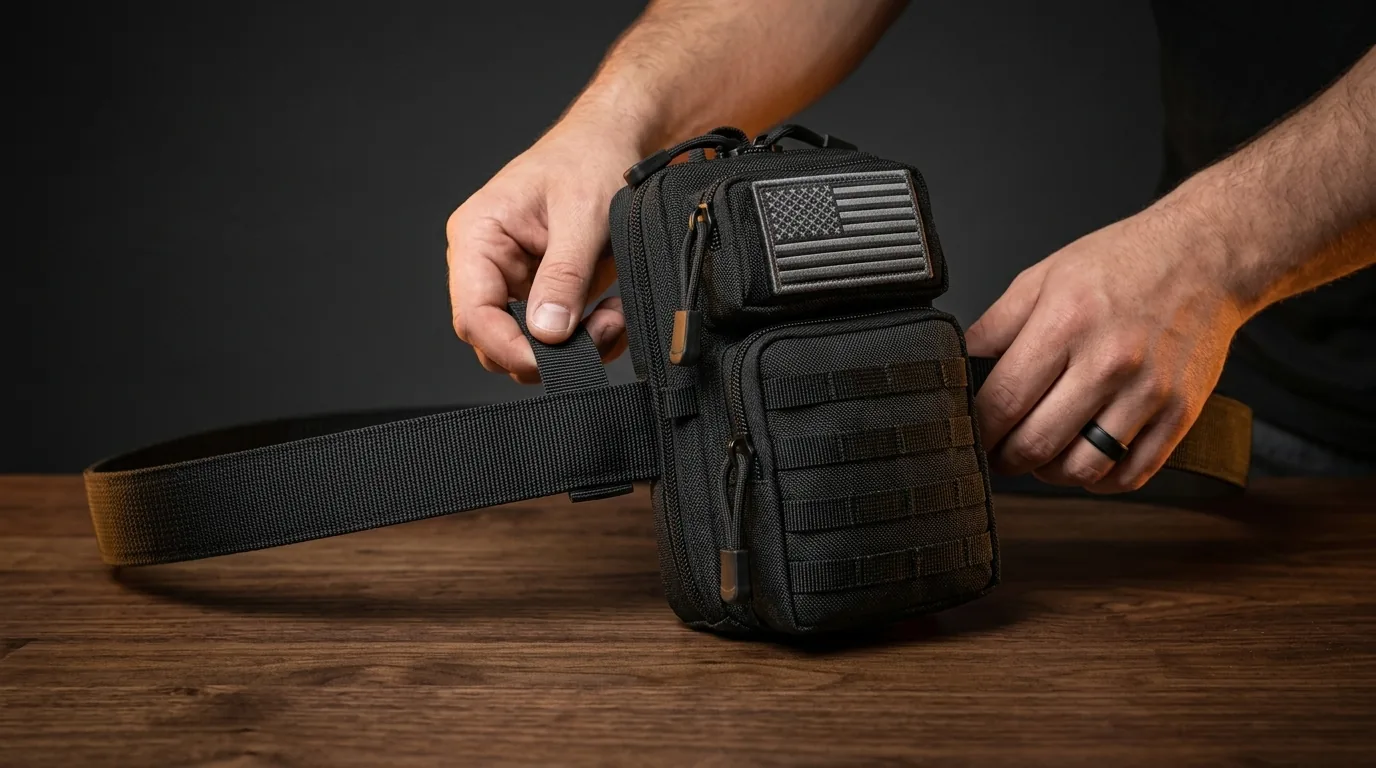
Match the attachment method to the belt. If you have a MOLLE or PALS belt with horizontal rows, align the pouch, weave each rear strap back and forth through both surfaces, and secure the ends. If you have a plain leather or nylon belt, use a belt adapter made for the belt width and pouch size—or choose a pouch with a real closed belt loop.
Do not simply pass long MOLLE straps behind an ordinary belt without weaving or a rated adapter. That shortcut leaves extra play, lets the pouch tip outward, and concentrates the load on a small part of the strap. A compact organizer should stay close to the body, remain clear of normal movement, and resist shifting when you walk, sit, bend, or get into a vehicle.
| Belt type | Best method | Main check |
|---|---|---|
| MOLLE/PALS belt | Weave the pouch straps through alternating rows on the belt and pouch back | Every available row is used and both ends are locked |
| Plain everyday belt | Use a compatible belt adapter or a pouch with a closed belt loop | Adapter matches the belt width and cannot rotate freely |
| Inner/outer hook-and-loop belt | Use the maker-approved mounting area or an adapter designed for that system | The pouch does not break too much hook-and-loop contact |
| Backpack waist belt | Use only webbing or attachment points intended to carry accessories | The pouch does not block adjustment, padding, or the buckle |
First, check that the belt and pouch are compatible
MOLLE is the broader load-carrying system; PALS is the grid of horizontal webbing used for attachment. In everyday shopping language, both are often called “MOLLE.” What matters is whether the belt has usable horizontal rows and whether the pouch has rear straps or connectors that can alternate through those rows.
- Count the rows: the belt must provide enough vertical space for the pouch straps to weave more than once.
- Check the channel width: the rear straps should line up with usable channels instead of pulling diagonally.
- Inspect the ends: snaps, tuck tabs, hook-and-loop ends, or other closures must reach their final locked position.
- Check the loaded size: a pouch that fits empty may sag or interfere with movement once filled.
If the belt has no attachment grid, read the belt as a plain belt—not as a partial MOLLE surface. Our guide to using a MOLLE pouch without MOLLE webbing covers adapters, internal carry, and other safe options.
How to weave a MOLLE pouch onto a PALS belt
- Unload the pouch. An empty pouch is easier to align and puts less strain on the belt while you work.
- Choose the position. Hold the pouch against the belt and confirm that it will not cover the buckle, adjustment tail, or an area needed for sitting and bending.
- Open the rear attachment straps. Lay them straight and remove twists.
- Start at the top belt row. Feed each strap behind the first usable row on the belt.
- Return through the pouch. Pass each strap back through the next webbing channel on the pouch itself. Pull the slack out evenly.
- Alternate belt, then pouch. Continue down one row at a time. The straps should bind the two surfaces together rather than hanging behind the belt.
- Secure the ends. Close the snaps, tuck tabs, or hook-and-loop ends exactly as designed. Do not leave the final section loose.
- Reload and test. Add the normal contents, then check for lift, twist, sag, and bounce.
The same alternating principle is used when you attach a MOLLE pouch to a backpack. A first-party MOLLE guide from Qore Performance likewise describes starting at the top, alternating between the carrier webbing and the attachment, and securing the bottom end. Zentauron’s step guide shows the same repeated tightening between carrier and pouch rows.
How to use a MOLLE pouch on a plain belt
A plain belt usually gives the pouch only one narrow strip to grip. The cleaner solution is a belt adapter that creates a small PALS panel and is made for the width of your belt. Feed the belt through the adapter according to its maker’s instructions, then weave the pouch onto the adapter as you would onto any other compatible panel.
Check three numbers before buying an adapter: the maximum belt width, the number of PALS rows it provides, and the usable width of the mounting panel. A wider adapter can spread the load better, but it also occupies more belt space. A very small adapter may allow a tall pouch to rock outward.
If the pouch has a separate closed belt loop supplied by its maker, use that loop as designed. Do not improvise with a carabiner, loose cord, or one unclosed strap for a loaded pouch. Those methods can swing, rotate, snag, or release unexpectedly.
Choose a position that works while moving
The best spot is not simply the first open section of belt. Put the unloaded pouch on the belt, then walk, sit in a firm chair, bend, reach, and step into a vehicle. Move it if the pouch presses into the hip, catches the seat belt, blocks a pocket, or changes how the belt closes.
- Keep the buckle clear. You should be able to open and adjust it without moving the pouch.
- Avoid the spine. A hard or overfilled pouch at the center of the lower back can be uncomfortable when sitting or falling.
- Protect normal movement. The pouch should not strike the thigh with every step.
- Respect vehicle restraints. Never place gear where it interferes with a seat belt or safe seating position.
Load the pouch for stability
Belt carry magnifies poor packing. Put denser items low and close to the belt side. Use internal pockets or elastic where available so a flashlight, power bank, keys, compact tool, cable, or small first-aid packet does not collect in one outer corner. Leave enough room to close the zipper without pressure.
A tactical organizer is still a small-item pouch, not a reason to put every tool on your waist. If the loaded pouch pulls the belt downward, folds the mounting panel, bounces during a short walk, or needs one hand to steady it, reduce the load or move the kit to a work bag, backpack, or vehicle organizer. The EDC pouch size guide explains why loaded thickness matters as much as length and height.
Run a five-point security check
- Lift: pull the pouch gently upward. The straps should not climb out of the rows.
- Twist: rotate it lightly left and right. A small amount of fabric movement is normal; free rotation is not.
- Walk: take a brisk walk and listen for hardware movement while feeling for bounce.
- Sit: confirm that the pouch and contents do not create a pressure point or block the buckle.
- Inspect: look for missed rows, twisted straps, open ends, stressed stitching, or an adapter that is too narrow.
Repeat the check after the first real outing and whenever you change the contents. Fabric settles, and a heavier load can reveal movement that an empty test misses.
Where a CobaltNook pouch fits
The CobaltNook Tactical MOLLE Organizer Pouch uses front webbing and a compact zippered layout for small everyday gear. It is offered for mixed-use kits such as cables, chargers, keys, flashlights, compact tools, and first-aid basics. Before mounting any pouch on a belt, inspect the live product photos and the attachment hardware you actually received; do not assume every front webbing row is also a rear mounting strap.
The current offer is a two-pouch pack in a selected color with two US flag patches. That lets one pouch stay in a work bag, truck, or travel setup while the other serves a compact belt or backpack kit when the mounting surface is compatible. Check the current product page for the live details.
Frequently asked questions
Can any MOLLE pouch attach to any belt?
No. A MOLLE pouch needs compatible belt webbing, a proper adapter, or a separate belt loop designed for that pouch. Belt width, webbing rows, strap spacing, and the loaded pouch size all matter.
Can I slide MOLLE straps over a normal belt?
That may leave the pouch loose and able to tip or rotate. A purpose-built belt adapter or closed belt loop is the safer, cleaner method for a plain belt.
How tight should a belt-mounted pouch be?
It should stay close to the belt and resist lift, twist, and bounce without folding the belt or making the buckle hard to use. Reduce the load if the belt sags.
Should I mount a pouch horizontally?
Only use a horizontal adapter or mounting method designed for the pouch and belt. Turning a vertical weave sideways without compatible hardware can leave the attachment incomplete.
Bottom line
Use the full weave on a PALS belt and a real adapter on a plain belt. Align the pouch, alternate every strap through belt and pouch rows, lock the ends, load it modestly, and test the setup while walking and sitting. If the pouch sags, rotates, interferes with movement, or cannot use enough rows, choose another position or carry method.
Sources and further reading
- Qore Performance: How to Use MOLLE — attachment sequence and final security check.
- Zentauron: How to Attach MOLLE/PALS Pouches — illustrated alternating-weave steps.