The short answer
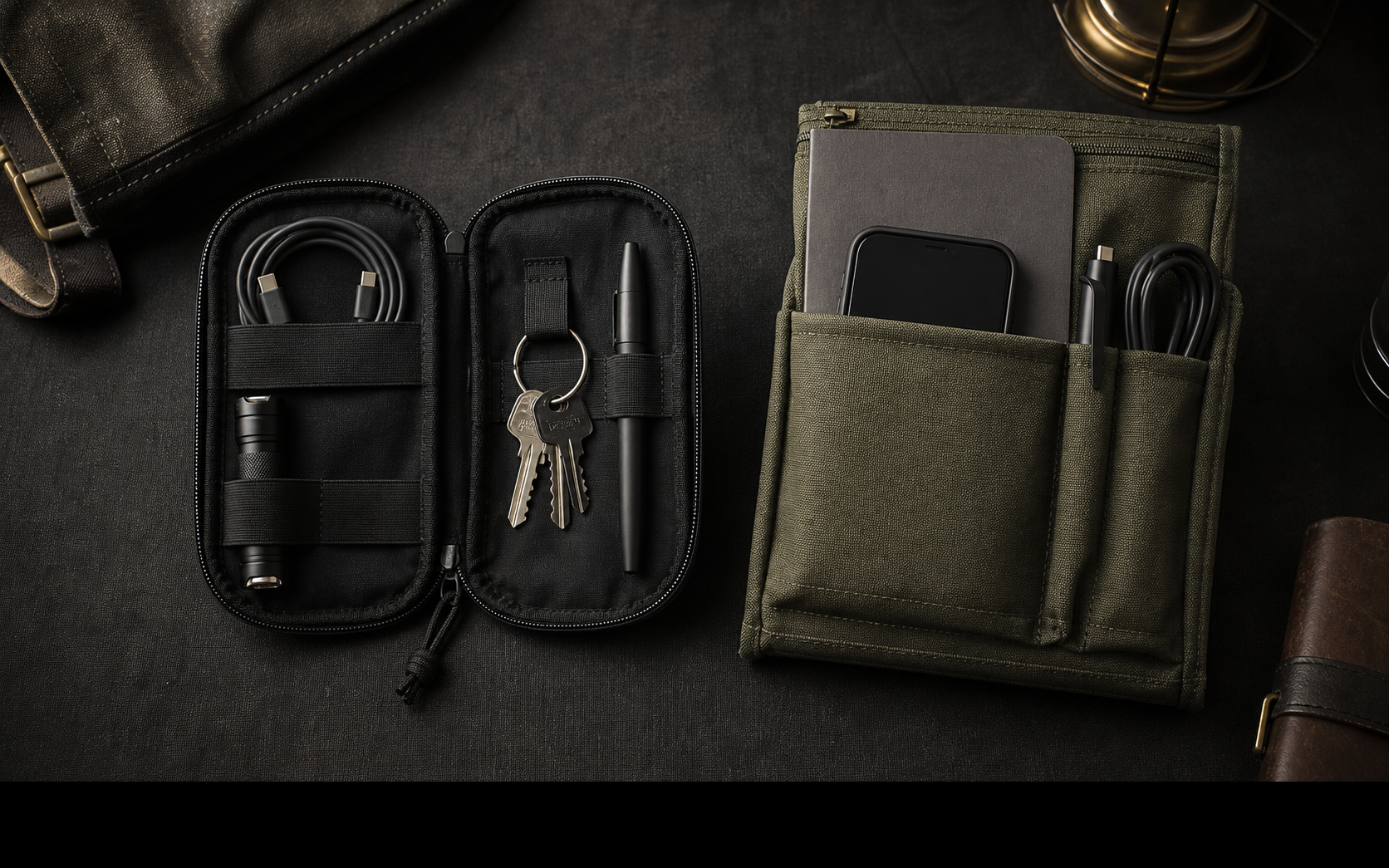
An EDC pouch organizes one small category of gear. A bag organizer insert organizes the larger bag around it. The pouch is usually enclosed and portable. The insert usually stays inside a backpack, tote, briefcase, or messenger bag and adds open pockets, sleeves, or a supporting panel.
That makes the decision less about which product has more pockets and more about where you want the organization to live. If the same charging kit follows you from a work backpack to a truck or hotel room, a pouch is the cleaner system. If one bag is your everyday base and loose items collect at the bottom, an insert may be more useful.
EDC pouch vs. bag organizer insert at a glance
| Question | EDC pouch | Bag organizer insert |
|---|---|---|
| Primary job | Contain one portable sub-kit. | Add a repeatable layout to a larger bag. |
| Typical format | Enclosed zippered pouch with loops, pockets, or a small main compartment. | Open pocket panel, liner, or removable insert with several sleeves. |
| Best contents | Cables, charger, keys, compact flashlight, adapters, small tools, or other mixed-shape items. | Notebook, tablet, phone, pens, documents, bottle, and other bag-level essentials. |
| Portability | Easy to remove and move as one loaded unit. | Removable, but usually selected to fit one bag size and layout. |
| Access | Open the pouch before reaching the contents. | Reach into open sleeves while the insert remains in the bag. |
| Space tradeoff | Adds a second container but limits one category. | Can use more of the main compartment and may reduce room for bulky cargo. |
| Best question | Which group of small items should move together? | Which items need a permanent place in this bag? |
What a bag organizer insert does well
A bag organizer insert gives a larger bag a pocket map. Instead of relying on one deep compartment, it adds sleeves and pockets for the items that should stay upright, separated, and visible. This is most useful when the outer bag has little internal organization or when the same backpack or tote is used almost every day.
The format is broader than one shape. Some inserts are full liners with walls and an open center. Others are flat or semi-rigid panels with pockets on both sides. TOM BIHN’s current Freudian Slip product page, for example, describes an organizational insert that adds pockets and storage for pens, papers, notebooks, and tablets. That is a first-party example of the insert job: organize the bag’s wider daily load rather than one small gear category.
An insert also reduces repeated setup when one bag stays in service. A notebook can return to the same sleeve, pens to the same row, and a phone or small tablet to the same pocket. The layout becomes familiar, so a missing item is easier to notice before leaving.
What an EDC pouch does well
An EDC pouch turns a small collection into a removable module. The outer bag does not need to know what is inside. A charging pouch can move from a work backpack to a carry-on. A small support kit can move from a truck to a garage shelf. A compact tool-and-light pouch can be removed when it is not needed.
This works especially well for irregular objects. Cables bend, keys catch on other items, a flashlight is round, and adapters are thick. An enclosed pouch keeps that mixed group from spreading through the bag. Vanquest’s current first-party guide to EDC organizer pouches describes pocket-sized organizers for small essentials and general-purpose pouches that consolidate electronics, tools, and other gear for transitions between work, travel, and everyday carry.
The pouch also creates a useful limit. When the zipper begins to strain or unrelated objects collect inside, the role needs editing. Our beginner’s EDC pouch guide explains how to give a small organizer one purpose instead of turning it into another junk drawer.
Which is better for a work bag?
Use a bag organizer insert when the whole bag needs structure. It is a strong fit for a notebook, tablet, pens, access card, phone, documents, and other items that return to the same bag every day. Open pockets reduce the need to unzip a separate container for every item.
Use an EDC pouch when one part of the load needs portability. Cables, wall charger, small flashlight, keys, USB drive, adapter, marker, and compact tool can form one support kit. If you switch bags, work from different desks, or sometimes leave the kit in a truck, moving one closed pouch is easier than emptying several insert pockets.
For a practical pouch-only layout, see our work-bag EDC setup. If your main question is whether a dedicated technology organizer is more suitable, compare the EDC pouch and tech pouch before buying another overlapping container.
Four common carry scenarios
One backpack, every workday
An insert usually wins when the bag rarely changes. Give the largest sleeve to the notebook or tablet, keep pens in one visible area, and leave the center open for lunch, a jacket, or project materials. Add a small pouch only if one category still needs to leave the bag as a unit.
Switching between work, travel, and personal bags
A pouch usually wins because the load can move without being rebuilt. Keep the kit narrow: charging gear, access items, or compact tools—not all three unless the size and access remain sensible. Packing a carry-on as layers? The packing cubes vs. EDC pouch guide separates clothing zones from small-item zones.
Truck plus work bag
Two pouches can divide roles cleanly. One stays with work electronics and access items; the other stays with vehicle support gear. An insert may still help the work bag, but the truck kit benefits from a closed module that can move to a toolbox or garage shelf. See the truck-kit pouch guide for the larger setup.
Desk-based work with many flat items
An insert or flat pocket panel often makes more sense when the daily load is notebooks, documents, pens, cards, and a tablet. A deep EDC pouch can hide flat items behind thicker gear. Keep only the cable-and-adapter category in a small pouch.
A seven-step decision test
- Empty the bag. Use the items carried during a real week, not a future wish list.
- Group by role. Separate writing, electronics, access items, tools, personal care, and safety gear.
- Mark what leaves the bag. Any group that regularly moves to a desk, truck, hotel, or second bag is a pouch candidate.
- Mark what stays. A notebook, tablet, bottle, and papers that live in one bag are insert candidates.
- Measure the bag interior. An insert that fits the opening but blocks the bag’s useful depth is not a good fit.
- Protect the main cargo zone. Leave space for the largest normal item rather than filling every pocket.
- Run a three-day test. If you keep removing the insert to reach the bag, or opening the pouch for every simple item, revise the system.
When the hybrid setup is best
The two products do not have to compete. A useful hybrid gives each layer a different job:
- Insert: shapes the whole bag and holds the notebook, tablet, phone, pens, cards, documents, and bottle.
- EDC pouch: contains one mobile sub-kit such as charging gear, compact tools, or access items.
This arrangement works only if the roles stay distinct. Putting several pouches inside a packed insert can create more fabric, zippers, and searching than the loose bag had in the first place. Start with one pouch. Add another only when a real movable category remains.
Fit and access details that matter
- Bag opening: a wide tote accepts a broad insert; a narrow backpack opening may not.
- Usable depth: compare the insert’s height and thickness with the bag’s normal cargo.
- Pocket direction: open pockets should remain upright in the way the bag is carried.
- Pouch opening: a clamshell shows more of the kit, while a top zip can suit a short list.
- Closure pressure: neither the bag nor pouch should need force to close.
- Removal path: a loaded pouch should lift out without snagging other contents.
Where the CobaltNook pouch fits
The current CobaltNook Tactical MOLLE Organizer Pouch sits on the portable-pouch side of this comparison. The current product page presents two-pouch and four-pouch loadouts for small items such as chargers, keys, flashlights, compact tools, and first-aid basics, with multiple color choices.
That makes it a practical sub-kit rather than a full bag liner. One pouch can own work-bag electronics and access items while another handles a separate truck, garage, range, camp, or travel role. Keep medical supplies clearly identified and separate when quick recognition matters; our EDC pouch vs. first-aid kit comparison covers that boundary.
MOLLE describes an attachment system, not the only way to use the organizer. A pouch can still ride inside a larger bag as a removable module. For the terminology, read the MOLLE pouch vs. EDC pouch guide.
Common mistakes to avoid
- Buying from pocket count alone: more pockets can consume useful space and slow access.
- Ignoring the largest daily item: an insert should not displace the jacket, lunch, files, or equipment the bag exists to carry.
- Making every category portable: some items can stay in one bag without needing another pouch.
- Using one pouch for unrelated jobs: separate roles before adding capacity.
- Leaving sensitive items exposed: open insert pockets are convenient, not automatically secure.
- Mixing safety gear into general clutter: first-aid and job-specific protective equipment need clear, appropriate storage.
Frequently asked questions
Is a bag organizer insert the same as an EDC pouch?
No. A bag organizer insert adds pockets or structure inside a larger bag. An EDC pouch is a self-contained zippered module that can move between bags, a truck, a drawer, or a desk.
Which is better for a work backpack?
Choose an EDC pouch when one small kit needs to move between locations or hold mixed items such as cables, keys, a flashlight, and adapters. Choose an insert when the backpack needs a stable pocket map for notebooks, a tablet, pens, and other daily items.
Can I use an EDC pouch with a bag organizer insert?
Yes. An insert can organize the whole bag while one EDC pouch contains a specific sub-kit such as charging gear, access items, or compact tools. The combination works best when each part has one clear job.
How do I stop a bag organizer from taking up too much space?
Measure the bag interior and the largest item you carry before buying. Choose an insert that leaves room for the bag’s main cargo, and avoid filling every pocket just because it is available.
Bottom line
Choose the location of the organization first. An EDC pouch is best when one small kit should move as a unit. A bag organizer insert is best when one larger bag needs a stable layout. For many work bags, the cleanest answer is one insert for the permanent daily load plus one pouch for the category that travels.
If the movable kit includes chargers, keys, a compact flashlight, adapters, or small tools, see the CobaltNook tactical pouch loadouts and give each pouch one clear role.
Sources and further reading
- TOM BIHN: Freudian Slip — first-party example of a removable bag insert that adds pockets for pens, papers, notebooks, and tablets.
- Vanquest: Organizer Pouches for EDC — first-party guide to pocket-sized and general-purpose organizers for electronics, tools, work, travel, and everyday carry.
- CobaltNook current pouch page — current loadout options, stated use cases, and product positioning checked before publication.