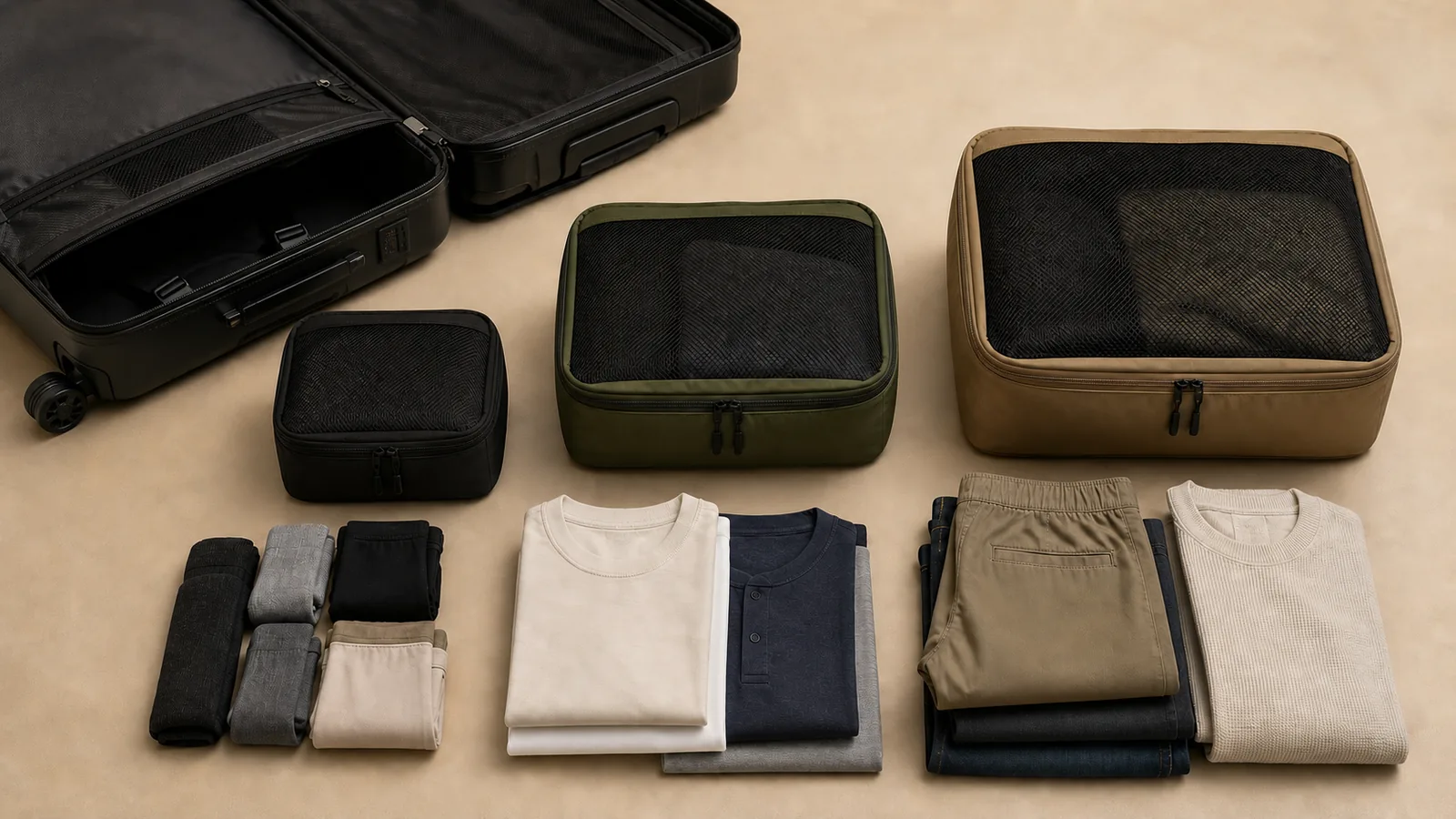
The short answer
For most carry-on packing, use a small cube for underwear and socks, a medium cube for tops, and a large cube only when pants, knitwear, or other bulky clothing truly need the room. A medium cube is often the most useful all-round size. It holds a meaningful clothing group but is still easy to move, stack, and fit around shoes or a toiletry bag.
Do not choose by the words “small,” “medium,” and “large” alone. Those labels vary between brands. Peak Design, for example, currently sells several named sizes from Small through Large, while other makers divide their ranges differently. Compare each cube’s listed dimensions with the usable interior of your suitcase or backpack.
This guide focuses on which sizes fit different clothing groups. If you are deciding how many pieces to pack, use our separate packing cube count guide for carry-ons.
Packing cube sizes at a glance
| Size role | Usually works well for | Watch for |
|---|---|---|
| Small | Underwear, socks, swimwear, sleepwear, baby clothes, or one compact workout set | Too many tiny cubes can fragment the bag and add zipper bulk. |
| Medium | T-shirts, casual tops, shorts, light trousers, or a short-trip clothing group | Overfilling can turn a flexible cube into a hard block. |
| Large | Jeans, trousers, sweaters, jackets, or shared family clothing | A loaded large cube can dominate a carry-on and slow access. |
| Slim or narrow | Rolled base layers, belts, scarves, or spaces beside handle rails | The long shape may be inefficient in short, wide luggage. |
These are practical roles, not standard dimensions. A “medium” from one brand can overlap with a “large” from another. Measure and test the actual combination before a trip.
When a small packing cube is the right choice
A small cube is best when the contents are compact, numerous, and easy to lose in a larger compartment. Underwear and socks are the clearest example. Keeping them together makes daily access simple and prevents them from filling gaps randomly around the suitcase.
Small cubes also suit swimwear, sleepwear, children’s clothing, or one workout set. The category should still be meaningful. If a cube contains only one belt or two pairs of socks, it is probably creating more structure than the trip needs.
- Use one when small pieces would otherwise scatter.
- Use one when the category must be accessible without opening a larger clothing cube.
- Use one when it fits a shallow corner or the space between suitcase hardware.
- Do not assume several small cubes use space better than one medium cube; seams and gaps take room.
Why a medium packing cube is the safest starting point
A medium cube is usually the most flexible choice because it matches the scale of everyday folded clothing. It can hold a stack of T-shirts, a group of shorts, or a balanced mix for a short trip without becoming as bulky as a fully loaded large cube.
Medium cubes are easier to rearrange. You can place two side by side, turn one ninety degrees, or pair one with a small cube. That matters because suitcase interiors are interrupted by wheel housings, handle rails, dividers, and curved corners.
For a solo carry-on, try one medium cube for tops and another for bottoms only if both groups justify the space. If one pile is much smaller, combine it or step down. Our carry-on packing cube setup guide shows how those zones work inside the full bag.
When a large packing cube helps—and when it gets in the way
A large cube earns its space when it holds a genuinely bulky category: jeans and trousers, sweaters, cold-weather layers, or clothing shared by two people. It can also work in checked luggage where the wider footprint is easier to accommodate.
In a carry-on, one large cube can become the entire packing plan. Once loaded, it may leave awkward spaces for shoes, toiletries, electronics, or a jacket. It can also be harder to remove without disturbing everything else.
Place the empty cube in the real luggage first. Confirm there is still room for shoes, toiletries, a travel layer, fast-access essentials, and laundry or purchases on the return trip. If not, split the category between medium cubes or reduce the clothing list.
How to choose the right size in five steps
- Measure the usable luggage interior. Measure between wheel wells, handle rails, dividers, and curved edges—not just the outside shell.
- Build clothing piles by purpose. Group tops, bottoms, underwear and socks, sleepwear, and special-use clothing.
- Match one cube to one useful group. Start small for compact pieces, medium for everyday clothing, and large only for bulky categories.
- Load without straining the zipper. A cube that becomes round, rigid, or hard to close is overfilled.
- Test the complete bag. Add shoes, toiletries, outerwear, and essentials. Zip the bag, stand it upright, reopen it, and confirm the layout still works.
This test matters more than a generic chart because it uses your real clothes, bag, and trip.
Match cube size to the luggage shape
Hard-shell carry-on
Hard-shell luggage often has two shallow halves. Medium and small cubes can be easier to divide across them than one deep large cube. Check the curve of the shell and the handle assembly.
Soft-sided suitcase
A soft-sided case may tolerate a slightly fuller cube, but overfilling still makes the bag hard to close. Keep the loaded cube rectangular and leave room for the case to flex.
Travel backpack
Backpacks are narrower and more curved. A medium cube or pair of smaller cubes often follows the back panel better than one wide cube. Read our packing cubes in a backpack guide.
Weekend duffel
A duffel has fewer fixed walls, so cubes add structure. Medium cubes are easy to stack or stand on edge, while one large cube may sag. See our weekend-bag setup.
Adjust the size mix to the trip
Two to three nights
Begin with one medium cube for main clothing and one small cube for underwear, socks, and sleepwear. A large cube is usually unnecessary unless bulky cold-weather clothing is involved.
Four to seven nights
Try two medium cubes plus one small cube. Use one medium for tops, one for bottoms or activity wear, and the small one for base layers. Plan rewearing or laundry before stepping up.
Business travel
Size alone does not protect structured clothing from wrinkles. Use a medium cube for casual pieces and consider a garment-focused system for dress clothes. Our packing cubes versus garment folder comparison explains the tradeoff.
Cold-weather travel
A large cube may be justified for sweaters or thermals, but wear the bulkiest coat in transit when practical. Compression reduces soft volume, not baggage weight. Compare regular and compression packing cubes.
Family travel
Use size to reflect each person’s clothing volume rather than giving everyone an identical cube. A child may need a small or medium while an adult needs a medium. One shared large cube can work for pajamas or swimwear.
How to tell whether a loaded cube fits correctly
A correctly loaded cube stays rectangular, closes without a fight, and can be lifted without fabric pulling hard around the zipper. Contents should fill the corners without creating a dome.
- Zipper: closes with normal hand pressure and no pinched fabric.
- Shape: remains flat enough to stack or place beside another item.
- Access: can be removed without unpacking the whole bag.
- Bag: luggage closes normally after shoes, toiletries, and essentials are added.
If the cube passes only when you sit on the suitcase or force the zipper, it is not the right size or the clothing list is too long.
Common packing cube size mistakes
- Buying by label alone: “medium” is not a standard measurement.
- Starting with the largest cube: it may encourage overpacking.
- Using one cube per outfit: too many containers slow access.
- Ignoring loaded thickness: an empty cube can become too deep when packed.
- Forgetting luggage hardware: wheels and rails reduce usable space.
- Using compression as a weight solution: volume falls, weight does not.
How to use the CobaltNook 8-set
The current CobaltNook gear lineup includes an 8-set packing cube system. Treat it as a menu of options, not a requirement to put every piece into one bag.
For a solo carry-on, start with three roles: a small piece for underwear and socks, a medium piece for tops, and the best-fitting remaining piece for bottoms or a bulky layer. Leave unused pieces for another traveler, checked luggage, laundry, or another trip.
If you are still deciding whether the system suits you, read our honest guide to whether packing cubes are worth it.
Frequently asked questions
What packing cube size is best for underwear and socks?
A small cube is usually the easiest starting point because it keeps compact items together without taking over the suitcase. The exact fit depends on trip length and the cube’s actual dimensions.
What packing cube size is best for shirts?
A medium cube is the most flexible starting point for T-shirts, casual tops, and light layers. It is usually easier to lift and rearrange than one oversized cube packed to its limit.
Should pants go in a large packing cube?
They can, especially with jeans, trousers, or a sweater. A medium cube may be better for a short trip or small backpack. Test the loaded cube in the real luggage before committing.
Do packing cube size names mean the same thing across brands?
No. Small, medium, and large are relative labels, not universal measurements. Compare listed dimensions with the usable interior of your luggage.
Bottom line
Use small packing cubes for compact items, medium cubes for most everyday clothing, and large cubes only for bulky categories or larger bags. Measure the usable luggage interior, load one clear category per cube, and test the full bag.
The most useful size is not the biggest one that closes. It is the smallest cube that holds its category comfortably while leaving the luggage easy to pack and use.
Sources and further reading
- Peak Design: Packing Cube — first-party example of multiple named sizes designed for suitcases and bags.
- Pack Hacker: Best Packing Cubes and selection considerations — current specialist guide covering sizes, shapes, materials, access, and compression tradeoffs.
- OneBag: Packing Clothes — detailed travel-packing reference on clothing movement, folds, wrinkles, and fitting a load to the bag.
- CobaltNook gear lineup — current product reference for the 8-set packing cube system, checked before publication.